.png)
Risk Ownership vs Decision Accountability

Updated: Apr 25

Introduction Risk Governance Appears Clear Until Decisions Are Taken
Most organisations believe they understand who owns risk.
Risk frameworks assign responsibilities across business units and functions. Committees review exposures. Escalation protocols ensure that issues are reported. Risk registers catalogue threats and mitigation actions. From a governance perspective, accountability appears clearly defined.
Yet when major failures occur, the problem is rarely that ownership was missing.
The problem is that the individuals responsible for managing risk were not the individuals who took the decisions that created it.
Strategic initiatives, product launches, outsourcing arrangements, and technology transformations routinely reshape an organisation’s risk profile through decisions taken in commercial and operational forums. By the time these changes appear within risk dashboards or governance reports, the underlying commitments have often already been made.
This creates a structural tension within many risk governance frameworks. Risk ownership sits in one part of the organisation, while decision authority sits in another. Governance mechanisms provide visibility over the resulting exposure, yet their influence over the decisions that generate that exposure remains limited.
This gap does not only create governance complexity. It weakens an organisation’s ability to align strategic ambition with operational resilience and ultimately erodes the board’s ability to safeguard long-term value.
Understanding the distinction between risk ownership and decision accountability helps explain why many risk frameworks function effectively as monitoring systems while struggling to shape outcomes. The sections that follow examine how this structural gap emerges and explore how organisations can redesign governance so that risk insight informs the decisions that shape exposure rather than merely documenting their consequences.
A practical way to detect this gap is to examine three questions when a major initiative is approved:
1. Who authorised the decision?
2. Who owns the resulting risk?
3. Who controls the resources required to address it?
When these answers point to different parts of the organisation, the governance framework may already be operating with a structural gap.
Executive Takeaways
For readers scanning rather than reading in full, five governing insights frame the argument:
Risk exposure is created through decisions, not frameworks. Strategic initiatives, operational changes and investment choices reshape the organisation’s risk profile long before exposure appears in risk registers or dashboards. Governance mechanisms frequently observe the consequences of these decisions rather than influencing the moment at which they are taken.
Risk ownership and decision authority perform different governance functions. Risk owners oversee exposure within defined domains through monitoring, control oversight and escalation. Decision-makers commit the organisation to actions that alter its risk profile. When these roles are not structurally connected, accountability for outcomes becomes difficult to locate.
Monitoring systems can create an illusion of control. Risk registers, RCSAs and key risk indicators improve visibility over emerging exposure. They rarely intervene at the point where strategic or operational choices are made. As monitoring infrastructure becomes more sophisticated, organisations may believe exposure is controlled while the decisions that generate it remain unchanged.
Effective risk governance requires alignment between ownership, authority and resources. Assigning responsibility for risk without the authority to challenge decisions or the resources required to mitigate exposure creates symbolic governance. Risk owners monitor and escalate developments, while the conditions that create exposure remain determined elsewhere in the organisation.
Boards govern risk by governing decisions. Oversight is most effective when directors understand where risk-creating decisions are authorised, how those decisions align with risk appetite and whether the resources required to manage the resulting exposure have been considered. Governing risk therefore requires visibility into decision architecture rather than reliance solely on risk reporting.
Who Owns the Risk vs Who Takes the Decision
Many organisations treat risk ownership and decision accountability as interchangeable concepts. In practice, they serve distinct governance functions.
Risk ownership defines responsibility for overseeing exposure within a defined risk domain. Decision accountability determines who is answerable for the choices that create or alter that exposure.
When this distinction is not explicit, governance structures may appear clear while responsibility for outcomes remains ambiguous.
The difference becomes clearer when the two roles are viewed side by side.

Risk Ownership
Risk ownership assigns responsibility for monitoring and managing a specific category of risk. The role typically sits with individuals or teams closest to the relevant operations or processes.
Typical characteristics include:
alignment with operational expertise
cross-functional interaction with multiple teams
focus on identification, mitigation, and monitoring of exposure
Risk owners maintain visibility over how risks evolve. They coordinate control activities, assess emerging threats, and report exposure through established governance channels.
This role ensures that risks are recognised, assessed, and managed consistently across the organisation.
Risk ownership therefore provides visibility and oversight of exposure.
It does not necessarily determine whether the organisation chooses to take that exposure in the first place.
Decision Accountability
Decision accountability sits with the individuals who possess authority to commit the organisation to a course of action. These decisions frequently reshape the organisation’s risk profile.
Typical characteristics include:
authority derived from organisational hierarchy
responsibility for strategic or operational commitments
visibility through governance escalation structures and approval processes
Examples include decisions to:
launch new products
expand into new markets
outsource critical operations
adopt new technologies
accelerate delivery timelines
Each decision alters the organisation’s exposure to operational, financial, strategic, or reputational risks.
The individuals responsible for those decisions therefore carry accountability for the resulting outcomes.
We also invite you to read about Strategic Uncertainty Governance: Who Owns Strategic Uncertainty?
Case Study: The Product Launch
Consider a financial services institution preparing to launch a digital product in a new jurisdiction. The initiative originates within the commercial leadership team, which identifies an opportunity to expand the organisation’s customer base and revenue streams. After internal review, the executive committee approves the initiative and allocates resources for its development and launch.
At that moment, a strategic decision has already been taken that materially alters the organisation’s risk profile.
Entering a new market introduces several categories of exposure, including regulatory compliance, operational capacity, technology resilience, and customer conduct risk. Responsibility for overseeing these exposures sits with the relevant risk owners across the organisation.
Risk owners perform their governance role by assessing the implications within their domain and evaluating whether existing controls remain adequate. The compliance function identifies licensing requirements, operational risk highlights capacity constraints, and technology risk evaluates the resilience of the supporting infrastructure.
These assessments clarify the exposure created by the strategic decision. However, the authority to determine whether the organisation allocates additional resources, adjusts the launch plan, or proceeds under current conditions remains with the executives responsible for the initiative.
The distinction between risk ownership and decision accountability therefore becomes visible. Risk owners analyse and monitor the exposure created by the decision, while decision-makers determine whether the organisation adapts its course.
Where governance functions effectively, risk insight informs adjustments before the exposure materialises. Where this interaction is weaker, initiatives proceed while risks are addressed incrementally through mitigation and monitoring.
The risk framework did not create the exposure in this scenario. It revealed the implications of a decision that had already been taken.
When Ownership and Authority Diverge
In many organisations, responsibility for managing risk exposure and authority for taking the decisions that generate that exposure sit in different parts of the governance structure. Risk owners are responsible for maintaining visibility over exposure within their domain. They manage risk registers, oversee the operation of controls, and monitor indicators that signal changes in risk levels. Their role is designed to ensure that risks are recognised, assessed, and managed consistently across the organisation.
Strategic and operational decisions, however, are taken elsewhere. Executives responsible for product development, technology, operations, or commercial performance determine which initiatives the organisation pursues and how resources are allocated. These decisions frequently reshape the organisation’s risk profile, often long before governance mechanisms recognise the implications.
When these responsibilities are not structurally connected, accountability for outcomes becomes difficult to locate. Risk owners oversee the exposure, while decision-makers determine the actions that create or alter that exposure. The organisation therefore separates the management of risk from the authority to accept it.
This separation creates a structural governance gap. Risk functions frequently observe the implications of decisions that have already committed the organisation to a particular course of action. By the time the exposure becomes visible within governance processes, the underlying decision may already be operationally or strategically embedded. At that point, risk management concentrates on mitigation and monitoring rather than influencing the decision itself.
The issue does not typically arise from the absence of formal risk frameworks. Most organisations maintain comprehensive policies, reporting structures, and escalation channels. The gap emerges because the architecture of decision-making operates alongside these frameworks rather than through them.
The Decision Architecture Principle
Risk governance is often approached as a framework design challenge. Organisations invest considerable effort in defining policies, assigning ownership, and strengthening reporting structures. While these elements remain important, they do not in themselves determine how risk is accepted within the organisation.
In practice, risk exposure is shaped primarily by the structure of organisational decision-making. Decisions concerning strategy, investment, product development, outsourcing, or operational change determine how the organisation’s risk profile evolves. The governance framework may reveal the implications of these choices, but it does not necessarily influence the moment at which the choice is made.
Risk governance is not solely a framework design problem. It is fundamentally a question of decision architecture.
The structure of decision authority determines how risk insight enters organisational choices, when escalation occurs, and where accountability ultimately resides. Where decision authority and risk ownership are aligned, information generated through risk management processes can influence decisions before exposure materialises. Where they diverge, governance frameworks tend to observe and manage the consequences of decisions that have already been taken.
Understanding the effectiveness of risk governance therefore requires examining not only the formal framework but also the architecture through which decisions are made.
The Illusion of Control in Risk Frameworks
Most large organisations maintain a substantial infrastructure dedicated to the identification and monitoring of risk. This typically includes risk registers, Risk and Control Self-Assessments (RCSAs), key risk indicators, and escalation protocols designed to surface emerging exposures.
These mechanisms play an important role in ensuring that risks are visible across the organisation. They structure risk identification, allow exposures to be documented and assessed consistently, and enable management to track developments through established governance channels.
However, the presence of this infrastructure does not necessarily mean that risk governance is influencing the decisions that shape the organisation’s risk profile.
Risk registers record exposures that have already emerged. RCSAs evaluate the effectiveness of controls within existing processes. Key risk indicators monitor signals that exposure may be increasing. Escalation protocols ensure that significant developments are communicated to the appropriate governance forums.
Together, these mechanisms improve the organisation’s ability to observe and manage risk once it becomes visible. They do not necessarily intervene at the point where the strategic or operational decision that generated the exposure is taken.
In practice, most risk exposure arises not from failures of monitoring but from ordinary organisational decisions. Product launches, market expansions, outsourcing arrangements, technology transformations, and operational redesigns all reshape the organisation’s risk profile long before those changes appear within risk registers or indicator dashboards.
When governance mechanisms focus primarily on documentation and monitoring, they risk becoming disconnected from the decisions that generate exposure.
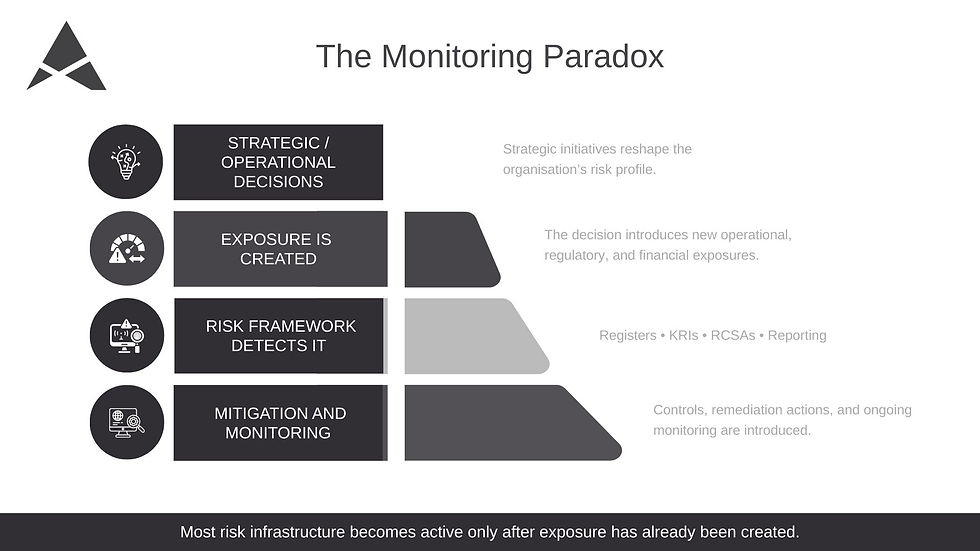
The Monitoring Paradox
The increasing sophistication of monitoring systems can create an unintended illusion of control.
Organisations invest heavily in dashboards, reporting frameworks, and indicator systems designed to provide greater visibility into risk. As these systems become more advanced, management gains access to more comprehensive information about the organisation’s exposure.
Paradoxically, this increase in visibility can reinforce the belief that risk is being effectively controlled.
In practice, monitoring systems typically detect the consequences of decisions that have already been taken. They reveal how exposure evolves once an initiative has been approved, a strategy implemented, or an operational change embedded within the organisation.
The result is a structural paradox.
Yet the influence of those frameworks over the decisions that shape exposure may remain limited.
In such environments, risk governance becomes highly effective at observing risk while remaining less effective at shaping the choices that create it.
Where Risk Exposure Actually Emerges
Risk exposure rarely originates from a single formal approval. In most organisations, it develops gradually through a series of operational and strategic decisions taken across different parts of the business.
These decisions may appear routine in isolation. A product launch is accelerated to capture market demand. A process is outsourced to improve efficiency. A technology platform is replaced to support growth. A new market is entered to expand the customer base. Each initiative is typically assessed within its immediate context and evaluated against its local objectives.
However, each decision also alters the organisation’s risk profile. Accelerating delivery timelines may increase operational fragility. Outsourcing key capabilities introduces dependencies on third parties. Entering unfamiliar markets exposes the organisation to new regulatory regimes and operational complexities. Technology changes can create integration challenges or resilience vulnerabilities.
Because these decisions are distributed across business units and taken at different points in time, their cumulative impact is not always immediately visible. Governance processes often evaluate each initiative separately, focusing on the risks associated with that particular decision rather than the aggregate effect on the organisation’s overall exposure.
Over time, the accumulation of these choices can gradually reshape the organisation’s risk profile. The organisation may find itself operating with higher levels of operational complexity, regulatory exposure, or technological dependency than originally intended.
Case Study: When RCSAs Miss the Shift
Risk and Control Self-Assessments (RCSAs) are designed to evaluate structural risks within established processes and whether the controls embedded in those processes operate effectively.
Consider a financial services organisation that performs annual RCSAs across core activities such as client onboarding, transaction processing, and customer servicing. Process owners identify risks, assess the effectiveness of controls, and update risk registers. Governance committees receive reports confirming that the organisation’s risk management framework is functioning as intended.
During the year, however, the organisation takes several strategic decisions. It launches a new digital product, expands into an additional jurisdiction, and outsources part of its customer servicing function. Each initiative appears manageable in isolation but collectively alters the organisation’s operating model by increasing operational complexity, regulatory exposure, and reliance on third parties.
When the next RCSA cycle occurs, the underlying processes appear largely unchanged and controls continue to operate as designed. From the perspective of the framework, the structural risks associated with the process remain controlled.
What the assessment does not fully capture is the cumulative effect of the decisions taken during the year. In practice, risk emerges through two different mechanisms. Structural risks arise from the design of processes and are well suited to periodic assessment through tools such as RCSAs. Instance-based risks, by contrast, arise from the specific decisions, transactions, or initiatives that occur within those processes.
These instance-based exposures are typically assessed within decision forums on a case-by-case basis rather than through the periodic review of the process itself.
This example illustrates a structural limitation of many governance tools. RCSAs are designed to evaluate whether controls function effectively within established processes. They are less sensitive to how strategic and operational decisions gradually reshape those processes over time or to the exposures that arise from specific instances in which those decisions are applied.
As a result, governance frameworks can continue to function as designed while the organisation’s underlying risk profile evolves.
This dynamic creates a subtle but important governance challenge. Risk tolerance does not always change through explicit decisions to accept greater exposure. Instead, it may shift incrementally as successive decisions introduce small adjustments to the organisation’s operating model.
Because these changes occur gradually, governance frameworks may continue to function as designed while the underlying level of exposure steadily evolves. Risk indicators remain within thresholds, control processes appear effective, and escalation mechanisms operate normally. Yet the organisation’s risk profile may have moved materially from the assumptions on which its governance structures were originally designed.
Understanding where risk exposure actually emerges therefore requires attention not only to formal approvals but also to the accumulation of ordinary operational decisions. It is within these distributed choices that the organisation’s risk profile is most often reshaped.
Boundary Friction and the “Hot Potato” Effect
Many material risks do not sit neatly within a single function. Instead, they emerge at the intersection of multiple parts of the organisation where responsibilities, incentives, and operational priorities differ.
Technology risk, for example, rarely belongs exclusively to the technology function. Decisions taken within technology may affect operational resilience, customer experience, and regulatory compliance. Similarly, product development often intersects with conduct and regulatory risk, while growth initiatives may introduce tensions with resilience and operational capacity.
These cross-functional interactions are inherent to modern organisations. Strategic initiatives frequently require coordination across product, technology, operations, compliance, finance, and risk functions. Each function contributes a legitimate perspective on the initiative and manages the risks that fall within its own domain.
Difficulties arise when the exposure created by a decision spans several functions but accountability for the resulting risk is not clearly defined across those boundaries.
In such circumstances, each function may recognise a portion of the risk while assuming that another team holds primary responsibility for addressing it. Technology teams may view an issue as an operational matter. Operations may consider it a product design problem. Compliance may treat it as a regulatory interpretation question. As these interpretations shift, responsibility can move between functions while the underlying exposure remains unresolved.
This dynamic creates what can be described as a “hot potato” effect. Risks circulate between teams as each function addresses the elements that fall within its remit while the broader issue remains only partially owned.
The challenge is rarely the absence of expertise or awareness. In many cases, multiple functions recognise the risk and take steps to address aspects of it. The difficulty lies in the absence of a single decision authority responsible for resolving the issue across functional boundaries.
Where governance structures do not clearly establish accountability for cross-functional exposures, organisations may experience prolonged discussions about ownership while operational decisions continue to move forward. Over time, the exposure becomes embedded within the operating model before a coordinated response is fully established.
This phenomenon highlights a broader characteristic of organisational risk. Some of the most consequential exposures do not originate within clearly defined functional domains. They arise in the spaces between them, where responsibilities overlap and decision authority is distributed.
This misalignment can be described as a Decision Governance Gap. It arises when the individuals responsible for managing risk exposure are not the individuals who possess the authority to take the decisions that create it.
Ownership Without Authority
Assigning risk ownership is often treated as a central element of risk governance. Organisations define risk domains, allocate responsibilities, and document ownership within policies and risk registers. On paper, these arrangements create the appearance of clear accountability.
In practice, however, assigning ownership does not automatically confer influence over the factors that determine how risks evolve. The effectiveness of risk ownership depends on the conditions under which that ownership operates.
For risk ownership to function as an operational control rather than a reporting mechanism, three elements must be present. First, the individual responsible for the risk must have sufficient authority to challenge decisions that materially affect exposure. Second, the organisation must allocate the resources required to implement mitigation actions when risks increase. Third, risk owners must have visibility into the decisions and initiatives that generate new exposure.
When these conditions are present, risk ownership can influence outcomes. Risk insight enters decision processes, mitigation actions are implemented in a timely manner, and exposure can be adjusted before it becomes embedded in the operating model.
When they are absent, the role of the risk owner changes in character. Ownership becomes primarily administrative. Risk owners maintain documentation, monitor indicators, and escalate developments through governance channels, yet have limited ability to influence the underlying drivers of exposure.
In such circumstances, risks are frequently created through decisions taken elsewhere in the organisation. Strategic initiatives proceed through commercial or operational decision forums, while the risk function records and tracks their implications within the governance framework.
The result is a form of symbolic governance. Responsibility for the risk appears clearly defined, yet the authority and resources required to influence the conditions that shape that risk remain located elsewhere.

Effective risk governance therefore depends not only on assigning responsibility for exposure but also on ensuring that those who hold that responsibility can influence the decisions that determine how exposure evolves.
The Cultural Dimension of Accountability
Accountability within organisations is often addressed through structural mechanisms. Governance frameworks define roles, allocate responsibilities, and establish escalation channels designed to ensure that risks are identified and managed appropriately. These structures provide clarity over who is responsible for different aspects of risk oversight.
However, accountability is not purely structural. It is also behavioural.
The ability of individuals to influence decisions that affect risk exposure depends not only on formal governance arrangements but also on the organisational environment in which those arrangements operate. Challenging decisions that carry commercial importance requires confidence, credibility, and the expectation that such challenge will be considered legitimate.
In many organisations, strategic initiatives are driven by strong commercial imperatives. Growth targets, delivery timelines, and efficiency objectives create momentum behind decisions that promise competitive advantage or operational improvement. Within this context, raising concerns about potential exposure can easily be perceived as slowing progress.
When organisational incentives consistently prioritise speed, growth, or efficiency, risk ownership can gradually become symbolic. Individuals responsible for risk oversight may recognise emerging exposures and record them within governance processes, yet feel limited responsibility for influencing the decisions that generate them.
This dynamic is rarely explicit. Most organisations encourage risk challenge in principle. In practice, behavioural signals often emerge through the way discussions unfold in decision forums. When commercial arguments dominate governance conversations, risk oversight can gradually shift from influencing decisions to documenting their consequences.
The result is a subtle erosion of accountability. Risks are recognised and reported, yet the willingness to challenge the decisions that generate those risks becomes weaker.
This dynamic becomes particularly visible in multinational organisations. Cultural norms influence how individuals approach authority, challenge, and disagreement. In some environments questioning senior decisions is considered a normal part of professional dialogue. In others, hierarchical expectations may discourage open challenge, particularly when initiatives carry strong commercial momentum.
The result is that the same governance framework may operate differently across regions or teams. Risk owners may formally hold the same responsibilities, yet their willingness to escalate concerns can vary depending on local cultural expectations and leadership behaviours.
Effective risk governance therefore depends not only on how responsibilities are allocated but also on whether the organisational environment supports the behaviours required to exercise them. Structures define accountability. Culture determines whether it is exercised.
The Role of the CRO and Risk Function
The structural tensions explored throughout this article inevitably reshape the role of the Chief Risk Officer and the broader risk function. If risk exposure is primarily created through decisions rather than through failures of control, then the effectiveness of risk leadership depends on where and how it participates in those decision processes.
In many organisations, the risk function is positioned primarily as an oversight mechanism. The Chief Risk Officer reviews proposals, evaluates the implications of initiatives that have already been designed, and provides independent challenge once decisions have largely taken shape. This structure ensures that governance procedures are followed, yet it often places the risk function at the end of the decision process rather than at its origin.
When risk leadership enters the discussion only after strategic or operational commitments have been formulated, its influence is naturally constrained. Commercial momentum, resource allocation, and organisational expectations may already favour implementation. Risk insights therefore tend to focus on mitigation and control rather than on shaping the direction of the initiative itself.
A more effective model positions the CRO and the risk function earlier in the decision lifecycle. Participation in strategy development, capital allocation, transformation programmes, and major operational decisions allows risk considerations to inform initiatives before key assumptions become embedded.
This approach does not replace managerial authority or slow decision-making. It ensures that risk expertise informs the evaluation of trade-offs that accompany major decisions. In this model, the CRO contributes to the design of organisational choices rather than simply reviewing their consequences.
Risk leadership therefore creates value when it shapes decisions rather than audits them.
Accountability Drift
Even when governance structures are initially well designed, alignment between decision authority and risk ownership rarely remains stable.
Organisations evolve continuously. Strategic expansion, technology transformation, organisational restructuring, and product innovation all reshape how decisions are made and where authority sits within the organisation.
Governance frameworks, however, often change more slowly. Risk registers, policies, and ownership assignments may continue to reflect the operating model that existed when the framework was originally designed.
Over time, this creates a gradual loss of alignment between the individuals responsible for overseeing risks and those who possess authority over the decisions that shape them.
This phenomenon can be described as accountability drift.
As decision structures evolve, ownership remains formally defined while authority shifts to new forums, initiatives, or organisational units. Risk owners therefore oversee exposures created through decision structures that no longer align with the original governance design.
Without periodic review of governance architecture, organisations may continue operating under accountability assumptions that no longer reflect how decisions are actually taken.
Aligning Ownership, Authority and Accountability
Effective risk governance depends on aligning several elements that are often treated separately within organisational frameworks. Much attention is typically given to the relationship between decision authority, risk ownership, and accountability for outcomes. In practice, however, alignment between these elements alone is often insufficient.
A fourth dimension must also be considered: resource authority.
Together these elements form what can be described as the Governance Alignment Model. Effective risk governance depends on aligning decision authority, risk ownership, accountability for outcomes, and the resources required to manage exposure.

In many organisations, the individuals or teams responsible for managing risk exposure do not control the resources required to address it. Strategic or commercial leaders may take decisions that reshape the organisation’s risk profile, while operational or risk teams inherit responsibility for managing the resulting exposure without the budget or operational capacity required to strengthen controls, redesign processes, or expand capabilities.
When this occurs, governance structures create a familiar imbalance. Responsibility for managing risk sits with one part of the organisation, while the authority to allocate the resources required to address that risk sits elsewhere.
In such environments, governance mechanisms such as reporting and escalation provide visibility but do not resolve the underlying structural gap. Risk owners may identify emerging exposure and document it within governance processes, yet lack the authority or funding required to materially change the conditions that created the risk.
Addressing this imbalance requires embedding risk considerations directly within the decision processes that shape exposure. When strategic or operational initiatives are proposed, discussions must consider not only the expected commercial benefits but also the resources required to manage the resulting risks. Decisions that materially alter the organisation’s risk profile should therefore be accompanied by clear commitments regarding the operational capacity, controls, and investments required to support those changes.
Several governance mechanisms can help support this alignment. Risk owners can participate in decision forums where significant initiatives are discussed, ensuring that risk considerations inform the design of proposed actions. Escalation thresholds can be linked directly to the individuals who possess authority to alter or halt initiatives that generate exposure. Risk appetite can frame strategic trade-offs so that discussions of growth, efficiency, and resilience occur within a shared understanding of acceptable exposure.
Ultimately, responsibility for managing risk must be accompanied by the authority and resources required to act. Assigning ownership without the ability to influence decisions or allocate resources creates responsibility without power.
When decision authority, risk ownership, accountability, and resource allocation operate together, governance becomes embedded within the organisation’s decision architecture. Risk insight informs strategic choices, operational teams possess the means to manage exposure, and accountability for outcomes remains clearly defined.
In such an environment, risk governance does not operate alongside decision-making. It becomes part of the mechanism through which organisational decisions are designed, evaluated, and implemented.
Strategic Implications for Boards
For boards, the implications of this discussion extend beyond the review of risk reports and control frameworks. Effective oversight requires attention to the organisational mechanisms through which risk exposure is created.
Directors are ultimately responsible for ensuring that the organisation’s strategy, operating model, and governance arrangements remain aligned with its capacity to absorb risk. This responsibility cannot be discharged solely through periodic review of risk documentation. It requires an understanding of how significant decisions are authorised, challenged, and resourced across the organisation.
In practical terms, this means that boards must maintain visibility over the decision architecture that shapes the organisation’s risk profile. Directors should be able to identify which executive forums have the authority to approve initiatives that materially alter exposure, how those decisions are assessed against the organisation’s risk appetite, and whether the operational capacity required to manage the resulting risks has been considered.
This perspective shifts the focus of board oversight in several important ways. Rather than concentrating exclusively on whether risks are monitored and reported effectively, directors examine whether governance arrangements ensure that risk considerations inform the design of major initiatives. Strategic discussions include not only the expected commercial benefits of proposed actions but also the operational implications for resilience, control environments, and resource allocation.
Boards also play an important role in ensuring that accountability remains clear as organisations evolve. Strategic expansion, technological change, and organisational restructuring can gradually shift decision authority and operational responsibilities. Periodic review of governance arrangements helps ensure that the allocation of decision authority, risk ownership, and resource authority continues to reflect the organisation’s current operating model.
Ultimately, the board’s role is not to manage risk directly but to ensure that the organisation possesses the governance mechanisms required to manage it effectively. This involves confirming that those who take decisions that reshape the organisation’s exposure do so within a framework that links authority, accountability, and the resources required to manage the consequences of those decisions.
When boards examine risk through this lens, oversight moves beyond the documentation of exposure. It becomes focused on the structures that determine how exposure is created, accepted, and managed across the organisation.
Board Oversight Checklist
Five Questions Directors Should Ask About Risk Governance
Which decisions within the organisation materially reshape our risk profile?
Directors should have visibility into the executive forums and governance processes where strategic, operational, and technology decisions that materially alter exposure are authorised.
How are those decisions assessed against the organisation’s risk appetite?
Boards should understand whether risk appetite informs strategic trade-offs at the point decisions are made, rather than being referenced only through periodic reporting.
Who is responsible for managing the risks created by those decisions?
Effective governance requires clarity regarding which individuals or functions oversee the resulting exposure across operational, regulatory, technological, or financial domains.
Do those responsible for managing the risk have the authority and resources required to address it?
Directors should consider whether risk ownership is supported by sufficient budget, operational capacity, and organisational authority to implement mitigation or strengthen controls when exposure increases.
When exposure increases, does escalation reach the individuals who can actually change the decision or allocate resources?
Escalation mechanisms should connect risk insight directly to the decision-makers capable of adjusting strategy, timelines, or investment levels.
Conclusion: When Governance Structures Do Not Match Decision Structures
Many organisations invest considerable effort in building robust risk frameworks. Ownership is assigned, policies are documented, dashboards are produced, and escalation mechanisms are defined. From a structural perspective, governance often appears comprehensive.
Yet when the architecture of decision-making evolves faster than governance arrangements, a gap emerges between the formal framework and the way the organisation actually operates. Decisions that reshape the organisation’s exposure may sit in different forums, involve different leaders, and require resources controlled by different parts of the organisation.
When this misalignment persists, its consequences become visible at the leadership level. The lack of authority and resources at the point where risks emerge often leads to a gradual upward shift in responsibility through escalation mechanisms. Risk owners identify exposure and report concerns, yet lack the means to address the underlying drivers. As issues escalate, responsibility for resolving them increasingly moves to senior executives who must intervene in operational matters that were originally created through earlier strategic or commercial decisions.
Boards experience a similar tension. Directors review risk dashboards that describe emerging exposure yet have limited visibility into the decision processes that produced it. When adverse outcomes occur, accountability can become difficult to trace because responsibility, authority, and resources no longer sit in the same place.
Over time, this disconnect can create a form of governance fatigue. Risk discussions focus increasingly on monitoring, reporting, and remediation rather than on the organisational mechanisms through which exposure is created. The framework continues to function, yet its influence over the conditions that generate risk gradually weakens.
Addressing this challenge does not require additional reporting or more elaborate policies. It requires ensuring that governance structures remain aligned with the organisation’s decision architecture as it evolves.
For boards and executives, the central question is therefore not only whether risk is being monitored effectively. It is whether the organisation’s governance arrangements ensure that those who shape its direction also carry clear responsibility, authority, and resources for managing the risks that follow.
In the end, governing risk effectively requires governing how decisions are made.
About the Author: Julien Haye
Managing Director of Aevitium LTD and former Chief Risk Officer with over 26 years of experience in global financial services and non-profit organisations. Known for his pragmatic, people-first approach, Julien specialises in transforming risk and compliance into strategic enablers. He is the author of The Risk Within: Cultivating Psychological Safety for Strategic Decision-Making and hosts the RiskMasters podcast, where he shares insights from risk leaders and change makers.