.png)
Connected Governance: The Foundation of Enterprise-Wide Decision-Making

Updated: Aug 14

Effective governance depends on more than individual structures, policies and reporting processes.
Modern organisations operate through increasingly interconnected functions, technologies, data, third parties, products and jurisdictions. This complexity distributes information, expertise and accountability across the enterprise.
Boards and executive teams need these perspectives to connect.
A technology issue can influence operations, customers, regulatory obligations and strategic priorities. A transformation programme can create dependencies across several functions and third parties. Emerging risks can become visible through separate operational, financial and customer signals.
Governance provides the structures through which these perspectives are brought together. Connected governance strengthens the relationships between information, accountability, decision-making and oversight across organisational boundaries.
These connections create enterprise awareness. Leaders gain a clearer understanding of how risks, dependencies, performance and emerging issues interact across the organisation. This supports informed decisions and coordinated action.
The concept builds on three dimensions of governance connectivity:
Information connectivity, connecting relevant information and signals across the enterprise.
Accountability connectivity, clarifying ownership across functions, dependencies and shared outcomes.
Decision connectivity, bringing relevant information, expertise and authority together for decisions with enterprise implications.
This article introduces the Governance Connectivity Model™ and explains how these three capabilities support enterprise awareness, decision quality, coordinated execution, organisational performance and resilience.
As organisational complexity increases, connected governance enables specialist functions and governance structures to operate as one coherent enterprise system.
Other articles in the series
In Organisational Silos: The Hidden Cost of Fragmented Governance, discover how fragmented governance limits enterprise awareness, weakens decision-making and creates hidden organisational risks.
In How Functional Silos Weaken Risk Identification and Escalation, explore how fragmented organisational structures prevent information from flowing across the enterprise, weakening both risk identification and timely escalation.
In How Organisational Silos Undermine Operational Resilience, we explore why resilience depends on connected governance that links people, processes, technology and decision-making across the enterprise.
In Enterprise Awareness: Seeing What No Function Can See Alone, explore how boards can connect information, weak signals and organisational dependencies to recognise emerging patterns, cumulative exposure and enterprise implications that no individual function can see alone.
Executive Takeaways
For readers scanning rather than reading in full, five governing insights frame the argument:
Organisational complexity increases the importance of governance connectivity.
Modern organisations distribute expertise, information and accountability across specialist functions, technologies, third parties, products and jurisdictions. Connected governance enables these perspectives to contribute to a coherent enterprise view while preserving the specialist expertise required to manage organisational complexity.
Enterprise awareness depends on connecting information, not simply increasing reporting.
Boards and executive teams already receive extensive management information, Key Risk Indicators (KRIs), operational reporting and specialist insight. Enterprise awareness develops when governance connects these signals, revealing relationships between risks, dependencies, performance and emerging issues that frequently elude through individual functional reporting.
Clear functional accountability needs to remain connected to enterprise outcomes.
Strategic initiatives, customer journeys, critical services and transformation programmes frequently cross organisational boundaries. Connected governance preserves clear functional ownership while rendering end-to-end accountability, organisational handoffs, shared dependencies and escalation authority visible across the enterprise.
Governance effectiveness is ultimately reflected in the quality of the decisions it enables.
Decisions with enterprise-wide implications benefit from relevant information, specialist expertise, clear accountability and visibility of organisational dependencies. Decision connectivity brings these perspectives together, helping leaders understand wider consequences and translate enterprise decisions into coordinated execution.
Connected governance enables existing governance disciplines to operate as one enterprise system.
The Governance Connectivity Model™ connects information, accountability and decision-making to create enterprise awareness, strengthen decision quality and support coordinated execution. Strategy, risk, performance and resilience retain their distinct purposes while contributing to a more coherent understanding of enterprise outcomes. The objective is greater connectivity within existing governance rather than additional governance structures.
Organisational Complexity Has Changed the Governance Challenge
Modern organisations depend on specialisation.
Technology, Operations, Finance, Risk, Compliance, Legal and other functions develop deep expertise that enables organisations to manage increasing complexity. Clear roles, responsibilities and specialist governance remain essential foundations for effective corporate and risk governance.
At the same time, organisations are becoming increasingly interconnected.
Strategic objectives and enterprise outcomes now depend on relationships across:
Functions, where responsibilities for common outcomes are distributed across specialist teams.
Technology, as platforms, applications and infrastructure support multiple business activities.
Data, which flows between systems, functions and governance processes.
Third parties, which increasingly provide critical technology, operational and professional capabilities.
Jurisdictions, where organisations navigate different regulatory and operating environments.
Products, which depend on capabilities distributed across the enterprise.
Critical services, which rely on combinations of people, processes, technology and external providers.
Transformation programmes, which create new connections and dependencies while changing existing ones.
This interconnected operating environment has changed the governance challenge.
Specialisation Distributes Organisational Knowledge
As organisations become more specialised, no single function has complete visibility across the enterprise.
Technology may understand system dependencies. Operations may recognise emerging process pressures. Compliance may identify regulatory implications. Risk may understand changes in exposure. Finance may assess financial consequences.
Each perspective can be accurate while remaining incomplete.
The challenge arises when an issue, risk or strategic decision crosses several of these boundaries.
A technology change, for example, may influence customer outcomes, operational resilience, regulatory obligations, financial performance and strategic objectives simultaneously.
A major transformation programme may create dependencies across Technology, Operations, Finance, Risk, Compliance and multiple third parties.
Individual functions can understand their respective responsibilities while the enterprise systemic implications remain obscured.
Governance Must Reconnect the Enterprise
Traditional governance provides the structures through which accountability, oversight and decision-making operate. Boards, executive management, committees, policies, controls and reporting mechanisms remain fundamental components of effective governance.
Organisational complexity creates an additional requirement:
Governance must connect those structures.
Boards and executive teams increasingly need visibility into:
how information from different functions relates;
where organisational dependencies intersect;
how accountability extends across functional boundaries;
where risks combine or amplify one another;
how decisions in one area affect outcomes elsewhere; and
which issues require an enterprise-wide rather than functional response.
This is the role of governance connectivity.
Connected governance enables specialist functions to retain their expertise and accountability while ensuring relevant information, perspectives and decisions connect when enterprise outcomes are involved.
It does not require every decision to become centralised or every function to receive every piece of information.
It requires the right connections at the right points in the governance system.
From Functional Visibility to Enterprise Awareness

The objective is ultimately to create enterprise awareness.
Enterprise awareness enables boards and executive teams to understand how information, risks, dependencies, decisions and strategic objectives interact across the organisation.
An organisation can have strong functional governance and still lack an integrated enterprise view. Effective connected governance brings those perspectives together so leaders can make decisions with a clearer understanding of their wider organisational implications.
Organisational complexity increases the value of specialist expertise. It also increases the importance of governance connectivity.
As organisations become more interconnected, governance effectiveness increasingly depends on the quality of the connections between their functions, information, accountability and decision-making. This is the foundation of connected governance and the enterprise awareness it is designed to create.
What Is Connected Governance?
Governance provides the structures through which organisations establish accountability, exercise oversight and make decisions. As organisations become more complex, the effectiveness of those structures increasingly depends on how well they connect.
Connected governance is the organisational capability that connects information, accountability, decision-making and oversight across organisational boundaries, enabling leaders to understand enterprise-wide implications and coordinate action.
The emphasis is on connection.
A board, executive committee, risk committee or specialist function may operate effectively within its individual mandate. Connected governance considers how those individual components interact as part of the wider governance system.
This matters because many important organisational outcomes no longer sit neatly within a single function.
Strategic initiatives cross business units. Critical services depend on technology and third parties. Risks interact across operational and organisational boundaries. Decisions made within one function can create financial, regulatory, customer or resilience implications elsewhere.
Effective governance needs to preserve specialist expertise while ensuring these wider connections remain visible.
Connected Governance Is Not More Governance
Connected governance does not require organisations to redesign every governance structure or introduce additional layers of oversight.
It does not mean:
Centralising every decision. Decisions should remain at the appropriate organisational level, supported by clear escalation when wider implications emerge.
Eliminating specialist functions. Functional expertise remains essential for managing organisational complexity.
Creating additional committees. More governance forums do not automatically create greater organisational connectivity.
Sharing every piece of information everywhere. Effective connectivity depends on relevant information reaching the people and governance forums that need it.
The objective is to strengthen the connections between existing governance structures so that relevant information, accountability and decisions can move effectively across organisational boundaries.
This shifts the focus from the quantity of governance to the quality of governance connectivity.
The Three Dimensions of Connected Governance
Connected governance can be understood through three interdependent dimensions.
1. Information Connectivity
Relevant information moves across organisational boundaries and is considered alongside other signals, risks and dependencies. This allows leaders to understand relationships that may remain invisible within individual functional reporting.
2. Accountability Connectivity
Ownership remains clear when responsibilities, decisions and enterprise outcomes extend across several functions. Leaders understand both their individual accountability and how it connects with the responsibilities of others.
3. Decision Connectivity
Decisions incorporate the relevant information, expertise, dependencies and organisational perspectives required to understand their wider implications. Escalation connects decisions with the appropriate level of authority when enterprise consequences emerge.
Together, these dimensions create the conditions for enterprise awareness.
They enable governance to move beyond a collection of individual structures and operate as a connected organisational system.
Connected governance does not replace existing governance structures. It connects them, enabling specialist expertise to contribute to enterprise-wide awareness and coordinated decision-making.
Information Connectivity Creates Enterprise Awareness
Most organisations do not lack information.
They generate significant volumes of operational data, risk reporting, financial information, customer insight, regulatory analysis, audit findings and management information.
The challenge is whether governance enables leaders to understand how that information connects.
Different functions naturally see the organisation through different perspectives:
Technology identifies system vulnerabilities, infrastructure dependencies and technology risks.
Operations sees process pressures, capacity constraints, incidents and operational dependencies.
Compliance identifies regulatory developments, breaches and areas of regulatory concern.
Customer-facing teams see complaints, service issues and changing customer behaviour.
Finance understands financial performance, resource constraints and potential financial consequences.
Risk monitors changes in exposure, emerging risks, controls and Key Risk Indicators (KRIs).
Each perspective can be valuable and accurate.
Each can also remain incomplete when considered in isolation.
A rise in customer complaints may appear manageable within Customer Support. Increased processing times may remain within Operations. Technology may separately report system capacity pressures. Risk may observe deterioration in a related KRI.
Individually, none of these signals necessarily indicates a material enterprise issue.
Synthesised, however, they reveal a different narrative.
From Information Flow to Connected Insight
Information connectivity is more than moving reports between functions.
It requires governance mechanisms that enable relevant information to be:
shared beyond the function where it originates;
interpreted alongside information from other parts of the organisation;
challenged through different functional and organisational perspectives;
escalated when wider implications become apparent; and
connected to decisions, dependencies and strategic objectives.
Management information and KRIs remain important components of this process. Their value increases when leaders can understand how individual indicators relate to other organisational signals.
The same principle applies to weak signals.
A near miss, recurring control exception, customer complaint or operational workaround may appear relatively insignificant independently. When similar signals emerge across several functions, they can reveal changes in organisational conditions that individual reporting channels may not identify.
Aggregation Is Not the Same as Connection
This distinction is fundamental to connected governance.
Organisations frequently aggregate information through dashboards, committee papers and board reporting. Aggregation brings information into the same place.
Connectivity explains the relationships within it.
A board pack containing reports from Technology, Operations, Compliance, Finance and Risk may provide extensive functional visibility. Enterprise awareness emerges when governance helps leaders understand:
where those reports describe different dimensions of the same issue;
where risks and dependencies intersect;
whether several weak signals indicate a broader pattern;
how developments in one function influence another;
where escalation or coordinated action is required; and
what those relationships mean for organisational objectives.
This changes the purpose of governance information.
The objective is not simply to provide leaders with more information. It is to provide the connections that enable them to interpret what that information means for the enterprise.
Information Connectivity Supports Earlier Intervention
Connected information also strengthens the relationship between risk identification and escalation.
When information remains within functional boundaries, emerging risks may appear isolated or relatively insignificant. Connecting information across functions can reveal patterns, dependencies and cumulative exposures earlier, allowing governance to recognise when a local issue is developing enterprise-wide significance.
This creates a progression:
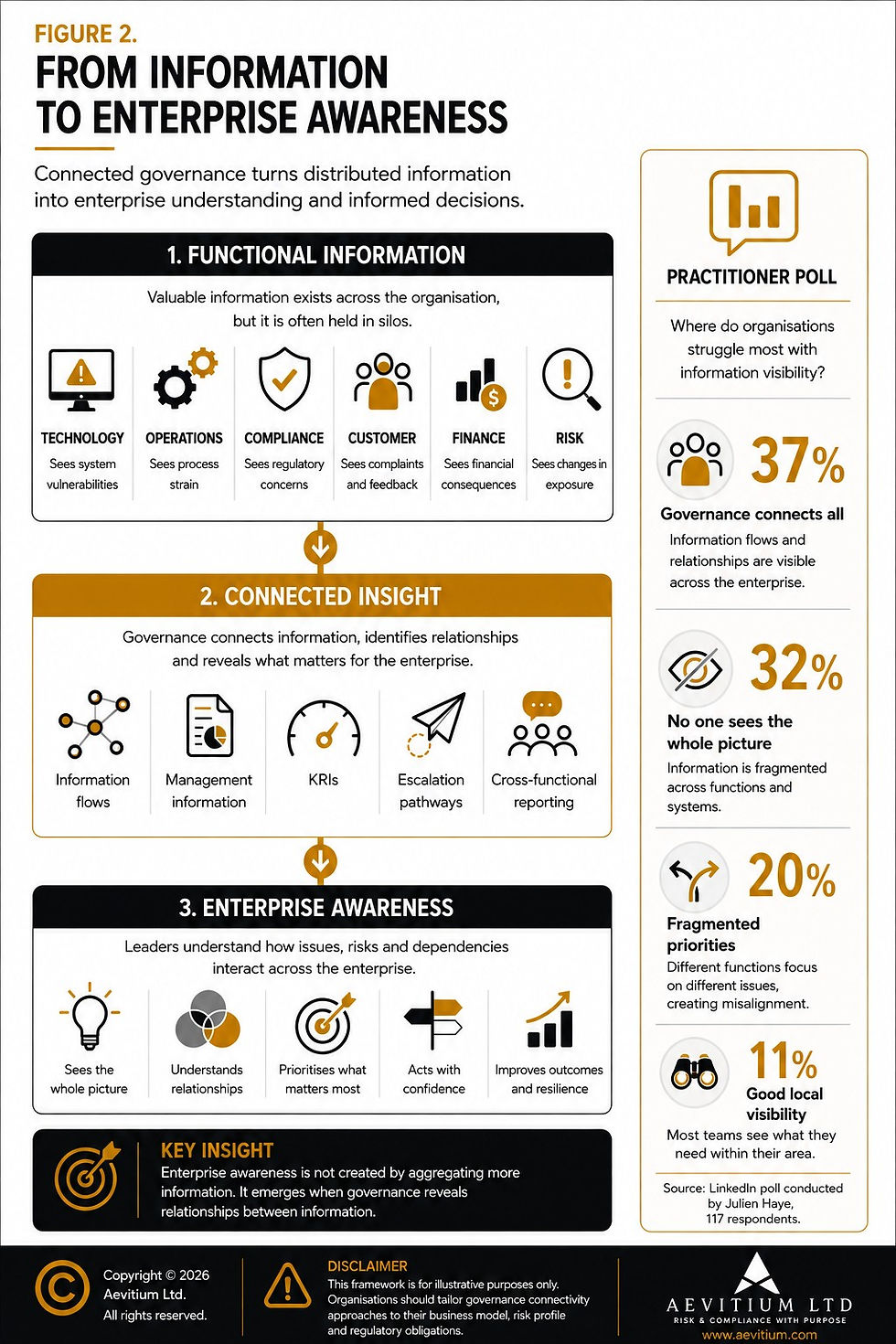
Enterprise awareness is not created by aggregating more information. It emerges when governance reveals relationships between information.
Information connectivity is therefore the first foundation of connected governance. It enables boards and executive teams to move beyond individual functional perspectives and develop a more coherent understanding of what is happening across the enterprise.
Accountability Must Follow Enterprise Outcomes
Organisational accountability is usually designed around structure.
Technology owns technology. Operations owns operational processes. Compliance owns compliance activities. Finance owns financial management. Risk provides oversight of risk.
Clear functional accountability remains essential. It establishes responsibility, supports effective oversight and ensures specialist activities have identifiable owners.
The challenge is that many of the outcomes organisations need to govern do not follow the same organisational boundaries.
A customer journey may depend on Technology, Operations, Compliance, Finance and external providers. A critical business service can cross several functions and legal entities. A transformation programme may require coordinated decisions across business units, specialist functions and executive management.
The organisational chart separates responsibilities.
Enterprise outcomes connect them.
Functional Accountability Is Only Part of the Picture
Connected governance distinguishes between functional accountability and accountability for enterprise outcomes.
Functional accountability answers questions such as:
Who owns this system?
Who operates this process?
Who manages this risk?
Who is responsible for this control?
Who approves this expenditure?
Enterprise accountability asks a different set of questions:
Who is accountable for the outcome created by these activities?
Who can see whether dependencies between functions are working effectively?
Who owns issues arising at organisational handoffs?
Who coordinates action when several functions contribute to the same outcome?
Who has authority to resolve competing priorities across those functions?
Both forms of accountability matter.
Connected governance ensures they remain aligned.
Handoffs Create Governance Vulnerability
Accountability often becomes less clear where responsibility moves from one function to another.
These organisational handoffs occur throughout modern businesses: between Technology and Operations, first and second lines, product teams and Compliance, internal functions and third parties, or individual committees with overlapping responsibilities.
Each function may fulfil its own responsibilities while an enterprise outcome remains insufficiently owned.
For example, Technology may successfully deliver a system change while Operations manages implementation, Compliance assesses regulatory requirements and Customer teams prepare communications. Each function can complete its individual responsibilities while coordination across the overall change remains weak.
This creates the potential for accountability gaps.
The vulnerability is not a total absence of accountability, but rather its fragmentation.
The governance question is whether ownership of the end-to-end outcome is equally clear.
Shared Outcomes Still Require Clear Ownership
Cross-functional working can sometimes create an assumption of shared accountability.
Collaboration is valuable. Accountability still needs precision.
When several functions contribute to an enterprise outcome, connected governance should make clear:
the end-to-end owner of the outcome;
the responsibilities of individual functions;
the points at which accountability transfers or overlaps;
the decisions each owner is authorised to make;
the escalation route when priorities conflict; and
who remains accountable for coordinating the enterprise response.
This becomes particularly important when functions have legitimate but competing priorities.
Technology may prioritise system stability. Operations may prioritise service continuity. Compliance may prioritise regulatory obligations. Finance may prioritise financial discipline.
Connected governance does not remove these perspectives. It ensures they can be reconciled around the enterprise outcome being governed.
Escalation Is Part of Accountability
Clear accountability also determines what happens when an issue exceeds an individual's authority or crosses organisational boundaries.
Effective escalation answers three questions:
Who owns the issue now?When does that ownership need to move?Who has authority to make the enterprise decision?
Without this clarity, issues can circulate between functions while each team continues operating within its own mandate.
With connected accountability, escalation becomes a deliberate transfer of decision authority rather than simply the upward movement of information.
Connected governance preserves functional accountability while making ownership across organisational boundaries visible.
This creates the foundation for the third dimension of governance connectivity: ensuring that information and accountability come together when decisions need to be made.

Decision Connectivity Determines Governance Effectiveness
Governance ultimately needs to enable effective decisions.
Committees, reporting, policies, controls and escalation mechanisms all contribute to that objective. Their value is realised when leaders can make informed decisions with a clear understanding of the consequences for the organisation.
This makes decision connectivity a critical test of governance effectiveness.
Decision connectivity is the ability to bring together the information, expertise, accountability and authority required to make decisions with enterprise-wide implications.
The concept matters because organisational decisions rarely remain confined to the function in which they originate.
Decisions Become Fragmented When Governance Becomes Fragmented
Consider an issue with technology, financial, customer and regulatory implications.
Different governance forums may see different dimensions of the same issue:
a technology committee considers system implications;
Finance assesses financial exposure;
Risk evaluates changes in risk;
Compliance considers regulatory consequences;
customer teams assess potential customer impact; and
executive management considers strategic priorities.
Each forum can make a reasonable assessment based on the information available to it.
The challenge emerges when those assessments remain disconnected.
Executives may receive different interpretations of the same issue. Decisions may occur at different speeds. One function may take action before another understands the implications. Dependencies may become apparent only after decisions have already been made.
The organisation can have multiple good decisions locally without achieving the best decision for the enterprise.
What Decision Connectivity Requires
Connected governance brings the relevant perspectives together when a decision has wider organisational consequences.
Effective decision connectivity considers:
Information: What do we know, and which relevant signals exist elsewhere in the organisation?
Expertise: Which functional perspectives are required to understand the issue properly?
Dependencies: What people, processes, technologies, third parties or services could the decision affect?
Risks: How could the decision change existing or emerging risk exposure?
Accountabilities: Who owns the decision, its implementation and its consequences?
Strategic objectives: How does the decision support the outcomes the organisation is seeking to achieve?
This does not mean every decision requires enterprise-wide consultation.
Governance should enable decisions to be made at the appropriate level, with connectivity increasing as the potential enterprise consequences increase.
A routine operational decision may remain entirely within one function. A decision affecting several critical services, regulatory obligations, customers or
strategic objectives requires a broader organisational perspective.
Decision Connectivity Is Also About Timing
Good decisions depend on more than access to information.
They depend on receiving the right information at the point when it can still influence the decision.
Information that reaches an executive committee after a material decision has been made may improve subsequent oversight, yet it cannot improve the original decision.
The same principle applies to escalation.
Effective governance connects emerging issues with decision-makers while meaningful options remain available. This requires clear escalation thresholds, appropriate decision rights and information flows capable of moving across functional and hierarchical boundaries.
Decision connectivity is therefore both a structural and temporal capability.
From Enterprise Awareness to Coordinated Action
The first three dimensions of connected governance now come together.
Information connectivity helps leaders understand what is happening across the enterprise.
Accountability connectivity establishes who owns the relevant outcomes and where authority sits.
Decision connectivity brings those elements together so that leaders can determine what the organisation should do.
The progression becomes:
Connected Information↓Enterprise Awareness↓Clear Accountability↓Informed Decisions↓Coordinated Action
This is where connected governance moves from organisational visibility to organisational performance.
A governance system should not be assessed solely by the volume of reporting it produces, the frequency of its meetings or the number of controls it maintains.
Its effectiveness is ultimately reflected in whether the organisation can use those structures to make timely, informed and coordinated decisions.
The quality of governance should ultimately be judged by the quality of the decisions it enables.
This also creates the natural location for your “Biggest governance benefit?” poll. Once the results are available, a short practitioner call-out can test whether respondents associate connected governance primarily with better decisions, faster escalation, enterprise visibility or stronger resilience, adding external practitioner evidence without interrupting the argument.
Governance Reporting Is Not the Same as Governance Connectivity
Most organisations do not lack governance information.
Boards receive dashboards and management information. Committees review detailed papers. Risk functions maintain risk registers and Key Risk Indicators (KRIs). Actions, incidents, control issues and remediation programmes are tracked through established governance processes.
These mechanisms provide essential oversight.
The more important question is whether they help leaders understand how developments in one part of the organisation connect with risks, decisions and outcomes elsewhere.
This distinction separates governance reporting from governance connectivity.
Reporting Creates Visibility. Connectivity Creates Understanding
Governance reporting primarily answers:
What is happening?
It may show that:
a KRI is approaching its threshold;
customer complaints are increasing;
a transformation milestone has been delayed;
a control issue remains unresolved;
technology incidents are becoming more frequent; or
a critical supplier is experiencing performance issues.
Each piece of information may be relevant and accurately reported.
Connected governance asks the next question:
How does what is happening here affect decisions, dependencies and outcomes elsewhere?
A deteriorating technology indicator may connect with operational delays. Rising complaints may provide another signal of the same underlying issue. A delayed transformation milestone may extend reliance on a legacy system. Supplier performance concerns may increase pressure on an already constrained internal process.
Seen separately, these developments generate governance information.
Seen together, they may reveal an enterprise pattern requiring coordinated attention.
More Reporting Does Not Necessarily Create Greater Awareness
As organisations become more complex, the natural response to emerging governance requirements is often to generate additional reporting.
More metrics are introduced.
More dashboards are created.
More information enters committee packs.
More actions are tracked.
The volume of governance information increases while the ability to distinguish what matters most can become more difficult.
This creates an important governance challenge: signal versus noise.
Governance signals are pieces of information whose significance increases when considered alongside other risks, dependencies, decisions or organisational developments.
Governance noise is information that consumes attention without materially improving understanding of the decisions or enterprise outcomes requiring oversight.
The distinction is contextual. The same information can be valuable for one decision and peripheral to another.
Connected governance helps leaders identify the relationships that give individual signals their wider significance.
How Should Boards Distinguish Signal From Noise?
Filtering governance information should not depend solely on whether an individual metric has breached a threshold. Weak signals often become significant through their relationship with other developments.
A practical rule is to elevate information for board scrutiny when information meets one or more of three conditions:
Connection: Does the signal relate to developments, risks or indicators elsewhere in the organisation?
Consequence: Could it materially affect customers, strategic objectives, critical services, regulatory obligations or organisational performance?
Trajectory: Is the signal recurring, accelerating or moving in a direction that could increase its significance?
An isolated issue with limited consequences and a stable trajectory may require routine monitoring. Several related signals, increasing exposure or wider enterprise consequences should trigger deeper analysis or escalation, even when individual indicators remain within established thresholds.
This approach helps boards filter governance information without relying exclusively on volume, severity or predefined thresholds.
The strongest governance signals are not always the loudest. Their significance often comes from their connections, potential consequences and direction of travel.
Governance Information Needs Context
Effective governance reporting should help boards and executive teams move beyond individual metrics toward understanding:
Relationships: Which issues, risks and indicators may be connected?
Dependencies: What other functions, services, technologies or third parties could be affected?
Trajectory: Are several signals indicating that organisational conditions are changing?
Accountability: Who owns the implications that extend across functional boundaries?
Decision relevance: What decision, intervention or escalation does the information require?
Enterprise impact: What could this mean for strategic objectives, customers, performance or resilience?
This does not require every governance report to become longer.
In many cases, greater connectivity should make governance reporting more focused by directing attention toward the information and relationships that matter for decision-making.
From Governance Information to Governance Insight
The value of governance reporting increases when information is placed in its wider organisational context. Knowing what is happening provides visibility. Understanding how an issue connects with other risks, dependencies and activities creates enterprise awareness. That awareness gives boards and executive teams a stronger basis for determining why an issue matters and what action may be required.
This is where governance connectivity adds value. It connects information that might otherwise be considered independently, helping leaders recognise patterns, understand wider implications and focus attention on issues that require escalation, intervention or coordinated action.
A dashboard may show that an indicator is deteriorating. Connected governance helps leaders understand whether that deterioration relates to changes elsewhere in the organisation, whether several signals point to the same underlying issue and whether the combined picture changes the significance of the information being reported.
The objective is not to transform every governance report into an enterprise-wide analysis. It is to ensure that information with broader implications does not remain confined to the function, metric or governance forum where it first becomes visible.
Effective governance reporting creates visibility. Governance connectivity turns that visibility into enterprise awareness that can inform decisions and coordinated action.

Connected Governance Aligns Strategy, Risk and Resilience
Organisations rarely manage strategy, risk, performance and operational resilience through exactly the same structures.
Strategy may be considered through executive and board planning. Risk operates through risk frameworks, committees and reporting. Performance is monitored through financial and operational measures. Operational resilience focuses on important business services, dependencies and the organisation's ability to continue delivering through disruption.
Each discipline has a distinct purpose.
They also influence many of the same enterprise outcomes.
A strategic decision can change the organisation's risk profile. Changes in risk can affect performance. Performance pressures can influence operational decisions and investment priorities. Resilience constraints can determine whether strategic objectives remain achievable during disruption.
Effective governance needs to make these relationships visible.
Strategy, Risk and Resilience Are Interdependent
Strategy establishes where the organisation intends to go and the outcomes it seeks to achieve.
Risk considers the uncertainty surrounding those objectives and the exposures created through their pursuit.
Performance provides insight into whether strategy is translating into expected organisational outcomes and where conditions may be changing.
Operational resilience supports the organisation's ability to continue delivering important business services when disruption occurs.
These perspectives provide different forms of organisational insight:
Strategy provides direction and priorities.
Risk provides insight into uncertainty, exposure and potential consequences.
Performance provides evidence of progress, execution and changing operating conditions.
Resilience provides insight into the organisation's ability to sustain critical outcomes through disruption.
Considered independently, each can provide valuable information.
Considered together, they provide a much stronger understanding of the organisation's position.
Fragmented Governance Can Fragment Enterprise Decisions
The challenge emerges when these disciplines operate through separate governance channels without sufficient connectivity between them.
A transformation programme may remain strategically attractive while introducing new technology dependencies and concentration risk.
Strong financial performance may coexist with increasing operational strain, deferred remediation or declining resilience capacity.
A decision to enter a new market may create opportunities for growth while changing regulatory obligations, third-party dependencies and operational requirements.
None of these perspectives invalidates the others.
Connected governance allows leaders to consider them together.
This enables boards and executive teams to understand not only whether a strategic initiative is progressing, for example, but also how it is changing risk exposure, organisational dependencies, performance conditions and resilience.
Connected Governance Creates Alignment
Connected governance does not combine strategy, risk, performance and resilience into a single discipline.
Their distinct purposes remain valuable.
Instead, it strengthens the relationships between them so that information and decisions can move across their respective governance structures when enterprise outcomes require a broader perspective.
This means ensuring that:
strategic decisions incorporate relevant risk and resilience implications;
risk information is considered in the context of strategic objectives and performance;
performance indicators are interpreted alongside changes in risk and operating conditions;
resilience considerations inform strategic choices, investment and prioritisation;
material changes in one area can trigger review or escalation elsewhere; and
boards and executive teams receive a connected view of enterprise implications.
The objective is alignment rather than uniformity.
Each discipline continues to provide its specialist perspective while connected governance ensures those perspectives contribute to a coherent enterprise view.
From Separate Disciplines to an Enterprise System
This distinction is central to the concept of connected governance.
Connected governance is not another governance discipline.
Adding it alongside risk governance, corporate governance, technology governance or operational resilience governance would recreate the fragmentation it is intended to address.
Instead, connected governance should be understood as an organisational capability that enables existing governance disciplines to operate as part of the same enterprise system.
Within that system, strategy, risk, performance and resilience continually inform one another.
Strategy establishes direction. Risk informs the uncertainty surrounding that direction. Performance provides insight into execution. Resilience helps leaders understand whether important business services can continue through disruption.
Connected governance creates the information, accountability and decision connections that allow leaders to consider these perspectives together.
Connected governance does not create another layer of governance. It connects existing governance disciplines so that strategy, risk, performance and resilience can inform enterprise-wide decisions.
This creates the foundation for the Governance Connectivity Model, which translates these relationships into a practical model for strengthening enterprise awareness, decision quality and coordinated execution.
Introducing the Governance Connectivity Model™
The preceding sections establish a consistent challenge.
Organisations already possess specialist expertise, governance structures, reporting processes and defined accountabilities. The opportunity is to ensure these components operate as a connected enterprise system.
The Governance Connectivity Model™ provides a practical way to understand how that connectivity can be created.
The model is built around three core capabilities: Information Connectivity, Accountability Connectivity and Decision Connectivity. Together, they strengthen enterprise awareness and create the conditions for better decisions, coordinated execution and stronger organisational outcomes.
Information Connectivity
Does relevant information move across organisational boundaries?
Information connectivity ensures that important signals do not remain confined to the function, system or governance forum where they originate.
It connects data, management information, Key Risk Indicators (KRIs), emerging risks, operational insight and other relevant signals so that relationships across the organisation can be understood.
Effective information connectivity helps organisations:
identify patterns across multiple sources;
recognise relationships between risks and dependencies;
connect weak signals before they develop into larger issues;
escalate information when its enterprise significance changes; and
provide decision-makers with relevant context rather than isolated data.
The objective is not unrestricted information sharing. It is ensuring that relevant information reaches the right governance forums and decision-makers when it can influence outcomes.
Accountability Connectivity
Is ownership clear where responsibilities and outcomes cross organisational boundaries?
Functional accountability establishes who owns individual activities, risks, controls and decisions. Accountability connectivity extends that clarity to outcomes involving several functions.
It makes visible how responsibilities interact across handoffs, shared dependencies and escalation points.
Effective accountability connectivity helps clarify:
who owns individual components of an enterprise outcome;
where responsibilities intersect or transfer;
who coordinates activity across functions;
when issues require escalation; and
who has authority when competing priorities require an enterprise decision.
This preserves specialist ownership while reducing the potential for accountability gaps between functions.
Decision Connectivity
Do enterprise decisions bring together the information, expertise and accountability required to understand their wider implications?
Decision connectivity brings the first two capabilities together.
It ensures that decisions with wider organisational consequences draw on relevant information, specialist expertise, dependencies, risk considerations, strategic objectives and clear accountability.
This does not require every decision to involve multiple functions. The level of connectivity should reflect the significance and potential enterprise impact of the decision.
Effective decision connectivity enables organisations to make decisions with a clearer understanding of what is known, who is accountable and how the consequences may extend across the enterprise.
The Three Capabilities Create Enterprise Awareness
Information connectivity provides the signals.
Accountability connectivity clarifies ownership.
Decision connectivity brings the relevant perspectives together when choices need to be made.
Combined, they create enterprise awareness: a connected understanding of risks, dependencies, performance, emerging issues and organisational priorities across functional boundaries.
Enterprise awareness is more than enterprise visibility. Visibility tells leaders what exists. Awareness helps them understand how different developments relate and why those relationships matter.
That distinction is central to the model.
Enterprise Awareness Strengthens Decision Quality
Better enterprise awareness provides a stronger foundation for decision-making.
Leaders can consider relevant information alongside competing priorities, dependencies, risk exposure and strategic objectives. They are also better positioned to identify where local decisions may create wider organisational consequences.
Decision quality improves through:
more relevant information;
broader organisational context;
clearer accountability;
earlier recognition of dependencies;
informed challenge; and
more proportionate consideration of risk and opportunity.
The objective is not perfect information. It is sufficient connected insight to make informed decisions at the appropriate time.
Better Decisions Enable Coordinated Execution
A sound enterprise decision still needs to translate into action.
This is where governance connectivity extends beyond the governance forum.
Coordinated execution requires functions to understand the decision, their respective responsibilities, the dependencies between their activities and the outcome the organisation is seeking to achieve.
Connected governance supports:
aligned priorities;
clear ownership;
effective organisational handoffs;
coordinated implementation; and
accountability for delivery.
This creates continuity between governance and execution, reducing the risk that an enterprise decision becomes fragmented as it moves back into individual functions.
From Connectivity to Performance and Resilience
The ultimate purpose of the Governance Connectivity Model™ is not connectivity itself.
It is to strengthen organisational outcomes.
When information, accountability and decisions connect effectively, organisations are better positioned to pursue strategic objectives, manage risk, coordinate execution and respond when operating conditions change.
The model creates a clear relationship between governance capability and enterprise outcomes:

The model should not be interpreted as a purely linear sequence. Information generated through execution and organisational outcomes feeds back into governance, allowing leaders to reassess risks, assumptions, priorities and decisions as conditions evolve.
Governance connectivity is not an additional governance discipline. It is the capability that enables existing governance disciplines to operate together as one enterprise system.
This is the central proposition of the Governance Connectivity Model™: effective governance depends not only on the strength of individual governance structures, but increasingly on the quality of the connections between them.
Case Study: Challenger and the Consequences of Disconnected Governance
The 1986 Challenger disaster is widely remembered as an engineering failure. The Rogers Commission also identified significant weaknesses in the decision-making process that preceded the launch.
Engineers at Morton Thiokol had raised concerns about the solid rocket booster O-rings at the unusually low temperatures expected for launch. Thiokol initially recommended against launching outside its previous temperature experience before management reversed that recommendation. Senior NASA decision-makers did not receive the full significance of the engineering concerns.
The Commission subsequently identified communication failures, incomplete information and weaknesses in how safety concerns moved through NASA's management structures.
Viewed through the Governance Connectivity Model™, the case illustrates three connected weaknesses:
Information connectivity: Critical technical signals did not reach all relevant decision-makers with their significance intact.
Accountability connectivity: Safety concerns crossed organisational boundaries without clear and effective escalation to those accountable for the final decision.
Decision connectivity: Engineering evidence, challenge and decision authority did not come together effectively before launch.
The lesson remains highly relevant for boards overseeing major technology migrations, product launches and transformation programmes. Formal governance processes provide structure. Their effectiveness depends on whether material information, accountability and challenge connect at the point where decisions are made.
Governance structures existed. Expertise existed. Information existed. The weakness was in the connections between them.
How Can Organisations Strengthen Governance Connectivity?
Strengthening governance connectivity does not necessarily require organisations to create new governance structures.
Most organisations already have boards, executive committees, risk forums, functional governance, reporting processes and defined accountabilities. The opportunity is to examine how effectively these existing components connect.
The Governance Connectivity Model™ provides a practical basis for doing this across information, accountability and decision-making, while also considering how governance forums interact and how decisions translate into execution.
Connect Information Across the Enterprise
Start by understanding how strategically important information moves through the organisation.
Information frequently travels vertically within functions more effectively than it travels horizontally across organisational boundaries. Technology information reaches technology governance. Risk information reaches risk committees. Operational information follows operational reporting lines.
Governance connectivity requires organisations to identify where information has implications beyond its original function.
Practical actions include:
mapping how material information moves between functions and governance forums;
identifying information that remains concentrated within individual reporting lines;
assessing whether KRIs, incidents, customer insights and emerging issues are considered collectively where relevant;
defining triggers for cross-functional sharing and escalation; and
reviewing whether board and executive reporting reveals relationships between important organisational signals.
The objective is relevant information flow, enabling leaders to recognise enterprise implications without creating unnecessary reporting volume.
Connect Accountability Around Enterprise Outcomes
The next step is to examine where organisational outcomes depend on multiple functional owners.
Critical services, customer journeys, strategic initiatives and transformation programmes often extend across several functions. Individual responsibilities may be clearly documented while end-to-end ownership remains less visible.
Organisations should identify:
which enterprise outcomes cross functional boundaries;
who owns the end-to-end outcome;
where important handoffs occur;
where responsibilities overlap or depend on one another;
who resolves competing functional priorities; and
when accountability transfers through escalation.
This provides a more complete view of ownership.
The aim is not to dilute functional accountability through collective responsibility. It is to make the relationship between individual accountability and enterprise outcomes explicit.
Connect Decisions to the Perspectives They Require
Not every decision requires enterprise-wide involvement.
Governance connectivity depends on recognising which decisions have consequences beyond the authority or visibility of the function making them.
Organisations can strengthen decision connectivity by identifying decisions that affect multiple:
strategic objectives;
functions or business units;
customers or stakeholders;
risks and controls;
technologies and data;
critical services; or
third-party dependencies.
For these decisions, governance should establish which perspectives need to be considered, who holds decision authority and what circumstances require escalation.
This allows routine decisions to remain efficient while ensuring decisions with wider implications receive an appropriately connected enterprise perspective.
Connect Governance Forums
Governance effectiveness is often assessed committee by committee.
Terms of reference are reviewed. Attendance is monitored. Papers are assessed. Actions are tracked. Individual committees may perform effectively against their mandates.
Connected governance introduces another question:
How effectively do the committees work together?
Boards and executive teams should understand how information, decisions and accountability move between governance forums.
This includes examining:
where committee mandates intersect;
how material issues move between forums;
whether different committees consider different dimensions of the same issue;
where decisions are made when responsibilities overlap;
how escalation routes operate between committees; and
whether information reaches the appropriate forum while it can still influence a decision.
The quality of an individual committee remains important. The quality of the connections between committees can be equally significant for enterprise governance.
Connect Governance With Execution
Governance connectivity should continue after a decision has been made.
Enterprise decisions often need to be implemented through multiple functions, each with different responsibilities, priorities and operating constraints. A decision that is clear within the governance forum can become fragmented as execution moves across the organisation.
Organisations should ensure that material decisions translate into:
clearly understood outcomes;
defined functional responsibilities;
aligned priorities;
coordinated implementation;
effective handoffs;
appropriate progress and risk information; and
escalation when execution diverges from the intended outcome.
This closes an important governance loop.
Information informs decisions. Decisions establish direction. Execution produces new information about performance, risk and changing conditions. That information should reconnect with governance when assumptions need to be reconsidered or further decisions are required.
Address the Organisational Friction
Governance connectivity depends on more than structures and information flows. It also depends on whether leaders are willing to operate across organisational boundaries.
Functional leaders may naturally prioritise their own objectives, resources and accountabilities. Incentives can reinforce local performance, while information may provide influence or decision-making authority. These conditions can create friction when enterprise priorities require greater transparency, shared insight or coordinated action.
Leadership plays an important role in aligning these interests. Organisations can strengthen connectivity by:
aligning incentives with enterprise as well as functional outcomes;
establishing clear expectations for cross-functional information sharing;
recognising leaders who contribute to collective outcomes;
creating escalation routes for unresolved cross-functional priorities; and
ensuring executive leadership reinforces enterprise accountability through its own decisions and behaviours.
The objective is to make collaboration across organisational boundaries part of how performance and accountability are understood, rather than relying solely on ad-hoc cross-functional goodwill.
Governance connectivity becomes sustainable when organisational incentives, leadership expectations and accountability reinforce the connections governance requires.
This addition improves the model because it acknowledges something important: connectivity is not frictionless. Information Connectivity + Accountability Connectivity + Decision Connectivity may be structurally sound, while incentives, power dynamics and functional priorities still determine how effectively those connections operate in practice.
Strengthening the Connections That Already Exist
Governance connectivity is ultimately a question of how the organisation operates as a system.
A practical review should examine whether information can move beyond functional reporting lines, whether accountability remains visible across shared outcomes, whether enterprise decisions incorporate the perspectives they require, whether governance forums interact effectively and whether decisions remain connected through execution.
This creates a different starting point for governance improvement.
Rather than asking:
What additional governance do we need?
organisations can first ask:
Where do the connections within our existing governance need to become stronger?
The objective is not more governance. It is greater connectivity within existing governance.
Five Questions Board Directors Should Ask About Connected Governance
1. Does our governance provide enterprise awareness or primarily functional visibility?
Boards may receive extensive reporting from individual functions while still lacking a connected view of the organisation. Directors should seek assurance that governance enables them to understand how information, risks, dependencies, performance and emerging issues relate across organisational boundaries, rather than considering each perspective independently.
2. How effectively does important information connect across functions and governance forums?
Information creates greater governance value when its wider significance can be recognised. Directors should understand how material information, Key Risk Indicators (KRIs), weak signals and emerging issues move between functions and committees, particularly when developments in one area have implications for decisions or outcomes elsewhere.
3. Is accountability clear when enterprise outcomes cross organisational boundaries?
Strategic initiatives, customer outcomes, critical services and transformation programmes frequently depend on several functions. Boards should seek clarity on end-to-end ownership, organisational handoffs, shared dependencies and escalation authority, ensuring functional accountability remains connected to responsibility for enterprise outcomes.
4. Do significant decisions bring together the perspectives required to understand their enterprise implications?
Decision quality depends on more than individual expertise. Directors should consider whether decisions with wider organisational consequences incorporate relevant information, specialist knowledge, dependencies, risks, accountabilities and strategic objectives before commitments are made, while allowing decisions with limited enterprise impact to remain appropriately delegated.
5. How do we know our governance structures operate as one connected enterprise system?
Individual committees, reporting processes and governance functions can each operate effectively while the wider governance system remains fragmented. Directors should seek evidence that information moves between governance forums, accountability remains clear through execution and decisions translate into coordinated action across the organisation.
Conclusion: From Governance Structures to Governance Connectivity
Organisations rarely lack governance.
Boards, committees, policies, reporting processes, risk frameworks and defined accountabilities provide essential structures for oversight and decision-making. As organisations become more complex, the effectiveness of these structures increasingly depends on how well they connect.
Information needs to move beyond the function where it originates. Accountability needs to remain clear when outcomes cross organisational boundaries. Decisions with enterprise implications need to incorporate the perspectives, dependencies and expertise required to understand their wider consequences.
This is the purpose of connected governance.
Across this series, organisational connectivity has emerged as a recurring governance challenge. Organisational silos fragment information and accountability. Functional silos weaken risk identification and escalation. Hidden dependencies reduce operational resilience. Each reflects a different consequence of the same underlying issue: governance structures can operate effectively individually while remaining insufficiently connected as an enterprise system.
The Governance Connectivity Model™ provides a way to address that challenge by connecting three fundamental capabilities:
Information connectivity, enabling relevant signals and insights to move across organisational boundaries.
Accountability connectivity, maintaining clear ownership across functions, handoffs and shared outcomes.
Decision connectivity, bringing together the information, expertise and authority required for enterprise-wide decisions.
Together, these capabilities create greater enterprise awareness, strengthen decision quality and support coordinated execution.
The objective is not to remove functional specialisation or centralise governance. Specialist expertise remains fundamental to effective organisations. The opportunity is to ensure those individual capabilities contribute to a coherent understanding of enterprise priorities, risks, dependencies and outcomes.
As organisational complexity continues to increase, governance effectiveness will depend increasingly on the quality of the connections between information, accountability, decisions and execution.
The future of governance is not more governance. It is connected governance.
About the Author: Julien Haye
Managing Director of Aevitium LTD and former Chief Risk Officer with over 26 years of experience in global financial services and non-profit organisations. Known for his pragmatic, people-first approach, Julien specialises in transforming risk and compliance into strategic enablers. He is the author of The Risk Within: Cultivating Psychological Safety for Strategic Decision-Making and hosts the RiskMasters podcast, where he shares insights from risk leaders and change makers.
Frequently Asked Questions
What is the difference between connected governance and traditional corporate governance?
Connected governance focuses on how information, accountability and decisions connect across organisational boundaries. Traditional corporate governance establishes structures for oversight, accountability and decision-making, while connected governance examines how effectively those structures operate together as an enterprise system. The concepts are complementary rather than competing approaches.
How can an organisation measure governance connectivity?
Governance connectivity can be measured by assessing how effectively information, accountability and decisions move across organisational boundaries. Useful indicators may include cross-functional escalation times, unresolved handoffs, duplicated committee reporting, decision implementation delays and instances where material dependencies are identified only after decisions have been made.
What are the warning signs of fragmented governance?
Common signs of fragmented governance include duplicated oversight, inconsistent risk information, unclear cross-functional ownership and repeated escalation of unresolved issues. Organisations may also find that individual committees perform effectively while senior leaders still struggle to develop a coherent enterprise view of risks, dependencies and decisions.
Can AI improve connected governance?
AI can support connected governance by identifying relationships across large volumes of risk, performance, operational and governance information. Its value lies in helping leaders recognise patterns and connections that may be difficult to identify through conventional reporting. Clear accountability, human judgement and appropriate oversight remain important when AI-generated insight informs governance decisions.
How should connected governance evolve as an organisation grows?
Connected governance should evolve as organisational complexity increases. New products, technologies, jurisdictions, third parties and business units create additional dependencies and decision pathways. Periodic reviews can assess whether information still reaches the appropriate governance forums, accountability remains clear and decision rights reflect the organisation's changing operating model.
How can boards obtain assurance over governance connectivity?
Boards can obtain assurance by assessing how the governance system operates across functions and committees, rather than reviewing individual components in isolation. Cross-functional governance reviews, committee effectiveness assessments, scenario exercises, decision reviews and independent assurance can help directors determine whether material information and accountability remain connected across the enterprise.
Is connected governance only relevant to large or regulated organisations?
No. Connected governance is relevant wherever organisational complexity distributes information, accountability and decision-making across multiple teams or functions. Smaller and growing organisations can experience governance fragmentation as they introduce specialist functions, new technologies, third parties, products or additional layers of management.
How does connected governance relate to the Three Lines Model?
Connected governance complements the Three Lines Model by improving connectivity while preserving distinct roles and responsibilities. It can help relevant information and insight move between management, risk and compliance functions and independent assurance without removing the accountability or independence expected within each line.