.png)
Enterprise Awareness: How Boards See What No Function Can See Alone

Updated: Aug 15

Boards and executive teams have access to extraordinary volumes of organisational information.
Financial performance, risk indicators, customer data, technology reporting, operational metrics, audit findings and regulatory developments provide increasingly detailed views of how individual parts of the organisation are performing.
The greater governance opportunity lies in understanding how these perspectives connect.
A technology issue may influence operational capacity. Operational pressure may affect customer outcomes. A transformation programme may increase reliance on critical people or third parties. Several individually manageable developments may collectively indicate a material change in enterprise exposure.
Recognising these relationships requires a capability that extends beyond functional visibility.
Enterprise awareness is the organisational capability to understand how information, risks, dependencies, decisions and changing conditions interact across the enterprise.
It enables boards and executive teams to recognise patterns across organisational boundaries, understand how dependencies influence enterprise outcomes and identify when changing conditions deserve greater attention.
This capability becomes increasingly important as organisations grow more interconnected. Specialist functions provide essential depth of expertise, while critical services, strategic objectives and major decisions increasingly depend on relationships that span multiple functions, technologies, third parties and governance structures.
Enterprise awareness brings these perspectives together.
This article explores how boards can develop a more connected understanding of the enterprise, from recognising weak signals and cumulative exposure to understanding dependencies and improving the interpretation of management information. It also examines how AI can support pattern recognition and how the Governance Connectivity Model™ provides the organisational connections through which enterprise awareness develops.
For boards, the objective is a coherent understanding of the relationships and changing conditions that could materially influence enterprise outcomes.
No individual function can see the whole enterprise. Effective governance enables the organisation to see what no function can see alone.
Other articles in the series
In Organisational Silos: The Hidden Cost of Fragmented Governance, discover how fragmented governance limits enterprise awareness, weakens decision-making and creates hidden organisational risks.
In How Functional Silos Weaken Risk Identification and Escalation, explore how fragmented organisational structures prevent information from flowing across the enterprise, weakening both risk identification and timely escalation.
In How Organisational Silos Undermine Operational Resilience, we explore why resilience depends on connected governance that links people, processes, technology and decision-making across the enterprise.
In Connected Governance: The Foundation of Enterprise-Wide Decision-Making, explore how connecting information, accountability and decision-making across organisational boundaries strengthens enterprise awareness, decision quality and coordinated execution.
Executive Takeaways
For readers scanning rather than reading in full, five governing insights frame the argument:
Enterprise awareness enables leaders to understand the organisation as a connected system.
Enterprise awareness is the organisational capability to understand how information, risks, dependencies, decisions and changing conditions interact across the enterprise. It enables boards and executive teams to connect specialist perspectives and develop a more coherent understanding of the conditions influencing enterprise outcomes.
Functional visibility provides depth, while enterprise awareness reveals relationships.
Technology, Operations, Finance, Compliance, Risk, Customer teams and Internal Audit each provide valuable insight into different dimensions of organisational performance and exposure. Enterprise awareness connects these perspectives, enabling leaders to recognise patterns and implications that may remain difficult to identify within individual functional reporting.
Weak signals and dependencies become more significant when considered collectively.
Customer trends, control exceptions, operational pressures, technology issues and other indicators may remain individually manageable. Their enterprise significance can increase when several signals connect around common services, dependencies or strategic objectives. Understanding connection, consequence and trajectory helps leaders recognise changing organisational conditions earlier.
Enterprise exposure can increase while individual indicators remain within established thresholds.
Risk appetite, tolerance levels, performance targets and control thresholds provide essential governance boundaries. Enterprise awareness complements these measures by revealing how operational pressure, technology dependencies, supplier concentration, transformation activity and other conditions can accumulate around the same enterprise outcome and alter the organisation's overall position.
Enterprise awareness strengthens decision-making by connecting current conditions with future consequences.
Significant decisions both depend on and reshape enterprise conditions. Boards benefit from understanding the risks, dependencies and organisational capacity surrounding a decision, alongside how that decision could change the enterprise position. The Governance Connectivity Model™ provides the connections through which relevant information, accountability and decision-making combine to create this awareness.
No individual function can see the whole enterprise. Effective governance enables the organisation to see what no function can see alone.
More Information Does Not Automatically Create Greater Awareness
Modern boards have access to more organisational information than ever before.
Management information, financial reporting and Key Performance Indicators (KPIs) provide insight into performance. Key Risk Indicators (KRIs) and risk registers provide visibility of exposure. Customer data, audit findings and regulatory information offer additional perspectives on how the organisation is operating.
Boards may also receive detailed reporting on:
technology performance and emerging vulnerabilities;
transformation programmes and strategic initiatives;
operational incidents and control effectiveness;
third-party performance and dependencies; and
operational resilience and critical business services.
Each source contributes valuable insight.
The governance challenge is connecting these perspectives into a coherent understanding of the enterprise.
Information Creates Visibility
Most organisational information is produced for a specific purpose.
Finance monitors financial performance. Risk assesses exposure. Technology monitors systems and infrastructure. Operations tracks service delivery. Compliance considers regulatory obligations. Customer teams observe changes in customer experience and behaviour.
This specialisation provides boards and executive teams with detailed insight into individual areas of the organisation.
Enterprise conditions, however, develop through the relationships between them.
A deterioration in technology performance may coincide with increasing operational workarounds, rising customer complaints and additional pressure from a transformation programme. A critical supplier may also be experiencing service issues.
Each development may remain manageable when viewed independently. Considered together, they may indicate growing pressure around the same service, systems and operational capacity.
From Information to Enterprise Awareness
This distinction sits at the heart of enterprise awareness.
Information tells leaders what is happening. Enterprise awareness helps them understand what those developments mean when considered together.
Enterprise awareness enables boards and executive teams to recognise relationships across different sources of information and understand how developments in one area may affect performance, risk, capacity or outcomes elsewhere.
This requires governance to provide context around:
which developments may be connected;
how organisational dependencies influence their significance;
whether several indicators point towards a common source of operational pressure or exposure;
whether the pattern is strengthening, recurring or spreading across the organisation; and
what the combined picture could mean for strategic objectives and enterprise outcomes.
The objective is greater understanding rather than greater reporting volume.
The Enterprise View Exists Between the Reports
A board can receive accurate information from every major function and still have an incomplete understanding of the organisation as a whole.
The missing insight may exist in the relationships between those reports.
A risk indicator becomes more meaningful when considered alongside operational performance. A technology issue acquires different significance when connected with customer impact. A transformation delay may warrant greater attention when viewed alongside capacity constraints, supplier dependencies and outstanding remediation.
Enterprise awareness makes these relationships visible.
It allows leaders to move from understanding individual developments to recognising patterns, dependencies and changing conditions across the enterprise.
As organisational complexity increases, this capability becomes increasingly important. Boards need access to high-quality information, together with governance mechanisms that enable them to understand how that information connects.
Information provides visibility. Enterprise awareness provides the context required to understand what that visibility means for the organisation as a whole.
What Is Enterprise Awareness?
As organisational complexity increases, no individual function, report or governance forum can provide a complete understanding of the enterprise.
Boards and executive teams need a broader capability that connects different perspectives and enables them to understand how developments across the organisation interact.
Enterprise awareness is the organisational capability to understand how information, risks, dependencies, decisions and changing conditions interact across the enterprise.
Enterprise awareness creates a connected understanding of the organisation. It brings together relevant perspectives so leaders can recognise relationships, interpret their significance and understand how developments in one area may influence outcomes elsewhere.
In practice, enterprise awareness involves:
Recognising relationships between organisational signals, including risks, incidents, performance indicators, customer insights and emerging issues.
Understanding dependencies across functions and services, including the people, processes, technology, data and third parties supporting enterprise outcomes.
Identifying how decisions in one area affect another, particularly where strategic choices create wider operational, financial, regulatory or resilience implications.
Seeing changes in organisational conditions, including emerging patterns, increasing pressure and shifts in exposure over time.
Connecting local developments with enterprise consequences, enabling leaders to recognise when an issue has significance beyond the area where it originates.
Maintaining sufficient awareness to support timely decisions, ensuring relevant insight reaches decision-makers while meaningful choices remain available.
Enterprise awareness is dynamic. As risks evolve, decisions are implemented and operating conditions change, the enterprise view needs to evolve with them.
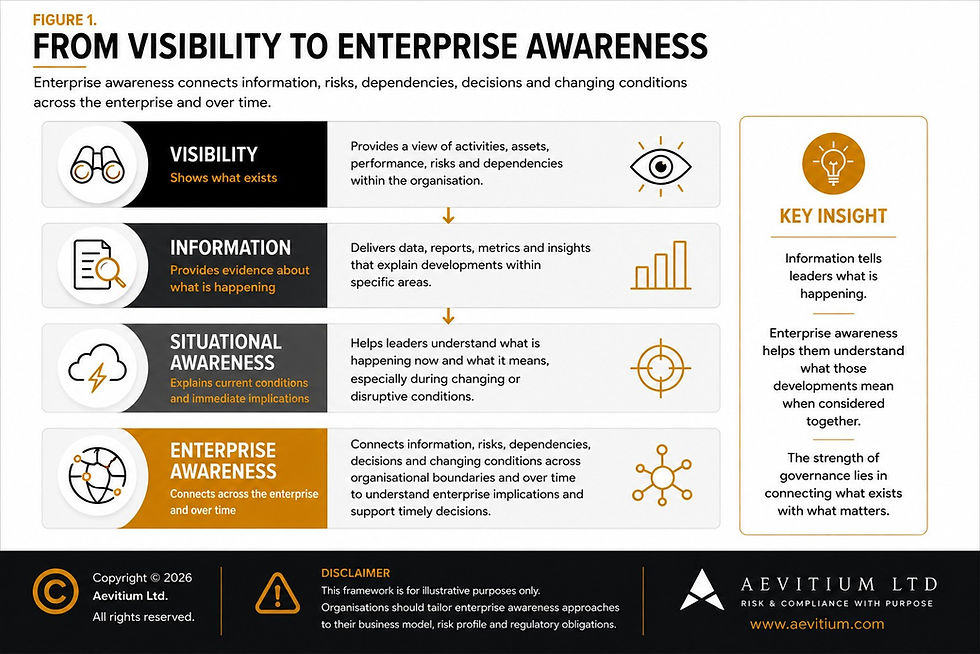
Enterprise Awareness Is More Than Visibility
Several related concepts contribute to enterprise awareness, although each serves a different purpose.
Visibility shows what exists. It gives leaders access to organisational activities, risks, performance, issues and dependencies.
Information provides evidence about what is happening. Reports, metrics, KRIs, KPIs, incidents and other sources help leaders understand developments within specific areas.
Situational awareness helps leaders understand current conditions. It becomes particularly valuable as circumstances change or during periods of disruption when decision-makers need a timely understanding of events and their immediate implications.
Enterprise awareness connects these perspectives across organisational boundaries and over time. It enables leaders to understand how information, risks, dependencies, decisions and changing conditions relate to one another and what those relationships mean for enterprise outcomes.
The distinction matters because an organisation can have extensive visibility and high-quality information while still finding it difficult to develop a coherent enterprise view.
Enterprise awareness requires connection and interpretation.
Enterprise Awareness Is an Organisational Capability
Enterprise awareness should also be understood as more than an attribute of individual leaders.
Experienced directors and executives bring judgement, institutional knowledge and perspective to governance. Their effectiveness is strengthened when the organisation itself can surface relevant relationships and provide a connected view of changing conditions.
This makes enterprise awareness an organisational capability.
It develops through governance arrangements that connect information across functions, make dependencies visible, preserve accountability and ensure relevant perspectives reach decision-makers.
The objective is not complete knowledge of everything occurring across the organisation. Modern enterprises are too complex for that to be realistic or useful.
The objective is sufficient connected awareness of the conditions, relationships and changes that could materially influence enterprise outcomes and decisions.
Enterprise awareness enables leaders to move beyond knowing what is happening within individual parts of the organisation towards understanding what those developments mean for the enterprise as a whole.
Functional Visibility Is Essential, Yet Incomplete
Enterprise awareness starts with strong functional visibility.
Specialist functions develop the expertise, information and oversight required to understand their respective areas of the organisation. This depth of knowledge provides an essential foundation for effective governance.
Different functions naturally see different dimensions of the enterprise:
Technology sees system performance, vulnerabilities, infrastructure constraints and technology dependencies.
Operations sees capacity, process performance, service pressures and operational disruption.
Finance sees financial performance, cost pressures, liquidity and the financial implications of changing conditions.
Compliance sees regulatory obligations, conduct concerns and changes in regulatory expectations.
Customer teams see complaints, service experience and changes in customer behaviour.
Risk sees movements in exposure, control effectiveness and emerging risks.
Internal Audit sees themes and patterns emerging through independent assurance.
Each perspective can be accurate and valuable.
The opportunity for enterprise awareness arises when leaders can understand how these perspectives interact.
When Individual Signals Form a Wider Pattern
Consider an organisation where several developments emerge over the same period.
Technology reports declining performance within an important platform, while service remains within established thresholds.
Operations introduces additional manual workarounds to maintain service levels.
Customer teams observe a gradual increase in complaints relating to processing delays.
Risk identifies increasing control exceptions, although individual indicators remain within tolerance.
Finance reports growing expenditure associated with operational support and remediation.
Viewed independently, each development may appear manageable within the responsible function.
Viewed together, they present a different picture.
The organisation may be experiencing increasing operational strain around a common service or dependency. Technology performance, operational workarounds, customer experience, control effectiveness and financial cost become connected signals of changing enterprise conditions.
No single function needs to possess the complete picture for its own information to be accurate.
The enterprise insight emerges from the relationship between the perspectives.
From Functional Expertise to Enterprise Understanding
This is why functional visibility and enterprise awareness serve different purposes.
Functional visibility provides depth. It enables specialist teams to understand developments within their areas, apply expertise and maintain effective oversight.
Enterprise awareness provides connection. It enables boards and executive teams to understand how developments across those areas interact and what their combined significance may mean for the organisation.
Strong enterprise awareness builds on functional expertise by connecting relevant perspectives where enterprise implications emerge.
This becomes particularly important when:
several functions identify different symptoms of the same underlying condition;
an issue creates dependencies across organisational boundaries;
individual indicators remain within tolerance while the combined pattern is changing;
decisions within one function influence outcomes elsewhere; or
local developments begin to have strategic, customer, financial, regulatory or resilience implications.
The governance challenge is to preserve the depth provided by specialist functions while creating sufficient connectivity to recognise these wider patterns.
No individual function needs to see everything. Enterprise awareness enables leaders to understand what becomes visible when relevant functional perspectives are considered together.

Why Board Packs Can Inform Without Creating Enterprise Insight
Board reporting provides an essential foundation for oversight.
Financial performance, risk exposure, operational delivery, technology, customers, compliance and transformation all require appropriate visibility. Specialist functions provide this through dashboards, committee reports, Key Risk Indicators (KRIs), Key Performance Indicators (KPIs) and management commentary.
The quality of individual reporting can be high.
Enterprise insight depends on an additional capability: understanding the relationships between what is being reported.
A board pack can contain all the relevant information and still leave the board without a coherent enterprise view.
Board Reporting Often Reflects Organisational Structure
Management information naturally follows established accountability and governance arrangements.
Technology reports technology performance.
Finance reports financial performance.
Risk reports changes in exposure.
Operations reports operational performance.
Compliance reports regulatory developments.
Individual committees may also provide updates aligned with their respective mandates.
This structure provides clarity and specialist depth. It can also leave important relationships between reports implicit.
A technology dashboard may show declining system performance. An operational report may identify increasing manual processing. Customer reporting may show longer service times. Risk reporting may identify additional control exceptions.
Each development can appear in a different section of the board pack, prepared by a different function and assessed against a different set of thresholds.
Enterprise awareness requires the board to understand that these developments may form one connected pattern.
Reporting Volume Can Obscure Relationships
The challenge becomes greater as reporting volumes increase.
More dashboards, metrics and commentary create greater functional visibility. They also increase the amount of information directors need to interpret and connect.
Several characteristics can make enterprise relationships particularly difficult to recognise:
Functional dashboards organise information around individual areas rather than shared enterprise outcomes.
Committee reporting can distribute related issues across several governance forums.
Backward-looking indicators provide evidence of realised performance while offering less visibility of changing conditions.
Inconsistent reporting periods make relationships and trajectories harder to compare.
Duplicated information increases reporting volume without necessarily adding insight.
Information without decision context explains developments while leaving their implications for upcoming choices unclear.
The issue is less about the availability of information and more about how that information is interpreted collectively.
Aggregation Is Different From Interpretation
Bringing multiple reports into one board pack creates aggregation.
Enterprise awareness requires interpretation.
Aggregation answers questions such as:
What is our financial performance?
What risks are increasing?
Which technology issues remain open?
How are operations performing?
What regulatory matters require attention?
Interpretation goes further.
It asks:
Which of these developments are connected?
Are several indicators revealing the same underlying condition?
Which dependencies explain the relationship?
Is the combined pattern becoming more significant?
What could this mean for enterprise outcomes?
Which decisions may need to change as a result?
This distinction matters because enterprise insight often exists between individual metrics rather than within them.
Stronger Reporting Makes Relationships Visible
Board reporting can strengthen enterprise awareness by making connections explicit.
This does not require every report to become longer or every metric to be combined into a single dashboard. It requires greater attention to the relationships that have material enterprise implications.
Stronger reporting helps boards understand four dimensions:
Relationships. Which risks, performance indicators, incidents and organisational developments influence one another?
Trajectory. How are these conditions changing over time, individually and collectively?
Dependencies. Which people, processes, technologies, data, third parties or services connect apparently separate developments?
Decision implications. What does the combined picture mean for strategic choices, priorities, escalation or executive action?
These dimensions move board reporting from presenting information towards supporting interpretation and judgement.
The objective is not a board pack that attempts to explain every connection across the organisation. It is a reporting system capable of highlighting the connections that could materially change how directors understand an issue or make a decision.
Effective board reporting provides visibility. Enterprise insight emerges when that reporting also reveals relationships, dependencies, trajectory and decision implications.
Weak Signals Become More Valuable When They Connect
Enterprise risks rarely arrive as a single, unmistakable warning.
They often develop through smaller changes in organisational conditions. Individually, these developments may remain within established thresholds and continue through routine management processes.
Examples include:
rising customer complaints;
recurring control exceptions;
employee concerns;
increasing staff turnover;
delayed remediation;
deteriorating supplier performance;
near misses;
increasing reliance on manual workarounds; and
declining system performance.
Each signal provides information about a particular aspect of the organisation.
Its enterprise significance can become clearer when it is considered alongside other developments.
A rise in customer complaints may warrant routine monitoring. When it coincides with increasing manual workarounds, declining system performance and higher staff turnover within the same service, the combined pattern provides a different level of insight.
Enterprise awareness enables leaders to recognise when several weak signals may reflect the same underlying organisational condition.
From Individual Signals to Emerging Patterns
Traditional reporting often evaluates indicators against predetermined thresholds.
This remains valuable. Thresholds help organisations identify material changes, trigger escalation and maintain consistent oversight.
Weak signals require an additional perspective because their significance may emerge through connection rather than individual severity.
A control exception may remain within tolerance.
A supplier may continue meeting its contractual service level.
Staff turnover may remain within an accepted range.
A remediation programme may be slightly behind schedule.
Individually, each condition may support continued monitoring. Collectively, they may indicate declining operational capacity, increasing dependency risk or growing pressure around an important enterprise outcome.
The governance task is to recognise these relationships while there is still time to understand their significance.
Connection, Consequence and Trajectory
Boards and executive teams can apply a simple three-part test when assessing weak signals:
Connection: Does this relate to other developments elsewhere?
Consider whether the signal shares a common service, process, technology, supplier, customer journey, strategic objective or organisational dependency with other developments. Connections can reveal a broader pattern that remains difficult to see through individual functional reporting.
Consequence: Could the combined pattern materially affect enterprise outcomes?
Consider the potential implications for customers, strategic objectives, financial performance, regulatory obligations, critical services or organisational resilience. Several individually modest developments can acquire greater significance when they influence the same enterprise outcome.
Trajectory: Is the pattern strengthening, recurring or changing direction?
Consider how the signals are evolving over time. Increasing frequency, longer duration, repeated recurrence or movement across several indicators can provide early evidence that organisational conditions are changing.
Together, these three dimensions provide a practical way to assess significance without relying exclusively on whether an individual indicator has crossed a predefined threshold.
Enterprise Awareness Strengthens Early Interpretation
Weak signals do not automatically indicate an emerging enterprise risk.
Their value lies in prompting informed interpretation.
Enterprise awareness gives leaders the context required to distinguish an isolated development from a connected pattern. It helps governance focus attention where relationships, potential consequences and direction of travel suggest that deeper analysis may be valuable.
This creates an important progression:
Individual signals provide evidence. Connected signals reveal patterns. Enterprise awareness helps leaders interpret what those patterns could mean.
The strongest governance signals are not always the most visible individually. Their significance often becomes apparent through their connections, their potential consequences and their trajectory over time.
Enterprise Risk Often Emerges Through Dependencies
Enterprise awareness requires more than understanding individual risks and signals. It also requires visibility of the dependencies that connect different parts of the organisation.
Modern organisations operate through interconnected networks of:
people, providing expertise, judgement and operational capacity;
processes, connecting activities and responsibilities across functions;
technology, supporting operations, customer journeys and decision-making;
data, flowing between systems, functions and external providers;
third parties, delivering services and capabilities across the value chain;
critical services, bringing multiple organisational capabilities together around important outcomes;
legal entities, creating ownership, financial and governance relationships;
jurisdictions, introducing different regulatory and operating requirements; and
transformation programmes, changing several of these relationships simultaneously.
Each dependency can be understood and governed individually.
Enterprise exposure becomes clearer when leaders understand how those dependencies interact.
Individual Dependencies Can Create Collective Exposure
Consider an important customer service supported by a core technology platform.
The technology dependency may operate within established tolerances. A critical supplier supporting part of the platform may also meet its contractual requirements. Operational teams may have sufficient capacity to manage normal service demand.
Each position can appear manageable.
The enterprise view may reveal additional connections.
The same supplier could support several components of the service. Operational teams may depend on manual workarounds when technology performance deteriorates. A transformation programme may be changing the platform while reducing available operational capacity. Several legal entities or jurisdictions may rely on the same underlying infrastructure.
These relationships change the significance of the individual dependencies.
The relevant governance question becomes broader than whether each dependency is being managed effectively.
It becomes:
What happens when several dependencies influence the same enterprise outcome at the same time?
Interaction Changes the Enterprise View
Dependencies can amplify one another.
A technology issue can increase manual processing.
Additional manual processing can place pressure on operational capacity.
Reduced capacity can increase processing delays and control exceptions.
A third-party disruption can intensify the same pressures.
A transformation programme can reduce available recovery options while those conditions persist.
The enterprise exposure develops through the interaction between these conditions.
This is particularly important for boards because individual functions may continue to report acceptable positions within their respective areas while the combined dependency network becomes progressively more exposed.
Enterprise awareness helps leaders recognise where several dependencies converge around:
a critical business service;
a strategic objective;
a major customer journey;
an important technology platform;
a concentrated third-party relationship;
a transformation programme; or
another material enterprise outcome.
From Dependency Mapping to Dependency Understanding
Mapping dependencies provides valuable visibility.
Enterprise awareness extends that visibility by helping leaders understand the relationships, concentration and potential interactions within the dependency network.
This involves considering:
where multiple enterprise outcomes rely on the same dependency;
where several dependencies converge around a critical service;
how disruption in one area could create consequences elsewhere;
whether changing conditions are increasing pressure across connected dependencies;
where alternative capacity or substitution is limited; and
how strategic decisions could alter existing dependency relationships.
This creates a more dynamic understanding of enterprise exposure.
A dependency map shows what the organisation relies upon.
Enterprise awareness helps leaders understand how those dependencies interact and what their combined significance could mean for enterprise outcomes.
Seeing Dependencies as an Enterprise System
The objective is to understand dependencies as part of a connected organisational system.
People depend on processes. Processes depend on technology and data. Technology may depend on third parties. Critical services depend on combinations of all of them.
Strategic and transformation decisions continuously reshape these relationships.
Enterprise awareness brings these connections into the governance view.
Enterprise awareness requires leaders to understand dependencies collectively, not simply identify them individually.
This enables boards and executive teams to recognise where interconnected dependencies could amplify exposure, constrain organisational choices or influence the organisation's ability to achieve strategic objectives and sustain critical outcomes.

Cumulative Risk Can Remain Invisible Within Individual Thresholds
Risk appetite, tolerance levels, control thresholds, performance targets and remediation deadlines provide essential reference points for governance. They help boards understand whether individual areas of exposure remain within agreed parameters.
Enterprise awareness extends this perspective by considering how several conditions interact across the organisation.
Consider an important business service experiencing increasing operational workloads, delayed remediation and growing reliance on a critical technology platform. The same service may depend on a concentrated supplier while a transformation programme draws on specialist resources.
Each indicator can remain within its approved threshold. Together, these conditions can create cumulative enterprise exposure around the same service.
Operational pressure can reduce available capacity. Delayed remediation can extend existing exposure. Technology and supplier concentration can increase dependency. Transformation activity can place additional demands on the people and systems supporting delivery.
The interaction between these conditions can gradually reduce the organisation's capacity to absorb further pressure or disruption.
Understanding the Combined Enterprise Position
Individual thresholds provide boards with important assurance about specific areas of performance and risk. Enterprise awareness adds a connected view of the organisation's overall position.
This requires attention to several factors:
whether multiple indicators affect the same critical service or strategic objective;
whether several conditions rely on common people, technology or third parties;
whether the combined trajectory is increasing enterprise exposure;
whether organisational capacity and flexibility are becoming more constrained; and
whether further change or disruption could materially affect enterprise outcomes.
This perspective helps boards understand how exposure develops through accumulation and interaction.
It also supports a more informed interpretation of risk appetite and tolerance. An organisation may remain within individual limits while several connected conditions place increasing pressure on the same enterprise outcome.
Enterprise awareness asks whether individually acceptable conditions remain acceptable when considered together.
For boards, this provides an important additional perspective on organisational risk. Individual thresholds establish defined boundaries. Enterprise awareness reveals how conditions interact across those boundaries and whether their combined effect is changing the organisation's capacity to achieve its objectives.
Decision-Making Both Depends on and Changes Enterprise Awareness
Enterprise awareness supports better decisions by giving boards and executive teams a connected view of the conditions surrounding them. It provides context on risks, dependencies, organisational capacity and changing circumstances before significant commitments are made.
The relationship also works in the other direction.
Decisions reshape the enterprise environment and therefore change the conditions that governance needs to understand.
A cost reduction programme can alter operational capacity and control resources. A technology decision can create new dependencies or concentration. An acquisition can introduce unfamiliar systems, suppliers and regulatory obligations. A transformation programme can change processes and temporarily increase execution risk. A new product can influence customer, operational and regulatory exposure simultaneously.
These decisions rarely affect a single organisational dimension. Their consequences move through the relationships that connect strategy, people, processes, technology, risk and performance.
Assessing the Enterprise Position Before and After a Decision
Enterprise awareness therefore needs to form part of the decision-making cycle.
Before a material decision, boards should understand the existing enterprise conditions surrounding it. This includes relevant dependencies, capacity constraints, concurrent change activity and areas where exposure may already be accumulating.
The first question becomes:
What does our current enterprise position mean for this decision?
The second question is equally important:
How will this decision change our enterprise position?
Together, these questions encourage leaders to consider both the conditions influencing a decision and the conditions that decision will create.
For example, a technology consolidation may improve efficiency and simplify infrastructure. It can also increase reliance on a smaller number of platforms or providers. Enterprise awareness enables leaders to understand these changing relationships as part of the decision itself and establish appropriate governance around the resulting dependencies.
Enterprise Awareness Is Dynamic
This creates a continuous relationship between awareness and decision-making.
Enterprise conditions inform decisions. Decisions change organisational conditions. Governance then needs to understand those changes as they influence subsequent choices.
This dynamic becomes particularly important when several strategic decisions are being implemented simultaneously. Transformation, cost management, technology investment, acquisitions and product development can each alter organisational capacity and dependencies. Their cumulative effects become part of the enterprise context for future decisions.
Enterprise awareness therefore extends beyond observing the organisation's current position. It helps leaders understand how decisions are changing that position over time.
Effective enterprise awareness informs decisions before they are made and tracks how those decisions reshape the conditions in which the organisation will make its next decision.
How Can Boards Develop Greater Enterprise Awareness
Enterprise awareness does not require boards to see every activity, metric or development across the organisation. Greater reporting volume can increase visibility while leaving directors with the same challenge of determining what matters at enterprise level.
The objective is to create sufficient connected awareness of the conditions that could materially influence enterprise outcomes.
Five disciplines can help boards strengthen this capability.
Connect Information
Material information needs to move across functional and governance boundaries when its significance extends beyond the area where it originates.
Boards should consider whether governance enables relevant insights from Risk, Finance, Operations, Technology, Compliance, Internal Audit and other functions to connect around shared enterprise outcomes. This includes ensuring that material developments can move between committees and reach the appropriate decision-makers without losing their context or significance.
The focus is on the relevance and connectivity of information, rather than the volume reaching the board.
Connectivity Also Depends on Organisational Incentives
Information does not move across organisational boundaries through governance structures alone. Functional priorities, budget ownership, performance incentives and concerns about accountability can influence what information is shared, how quickly concerns are escalated and how issues are framed.
These dynamics become particularly important when information could expose delivery problems, challenge an existing decision or create additional responsibility for another function. Leaders therefore need to consider the organisational conditions surrounding information flow alongside the formal reporting and escalation mechanisms.
Boards can seek evidence that incentives, leadership expectations and governance behaviours support appropriate information sharing across functions. They can also examine whether challenge is welcomed, whether escalation creates constructive action and whether ownership remains clear when an issue crosses organisational boundaries.
Enterprise awareness depends on more than access to information. It also depends on organisational conditions that allow relevant information to move, connect and retain its significance.
I prefer this framing to explicitly writing about “data hoarding” or “internal blame cultures.” Those terms are somewhat loaded and would pull the article away from its governance focus. The paragraph acknowledges the reality of corporate politics through incentives, budget ownership, accountability, escalation and leadership behaviour, which is more consistent with the article and your executive audience.
Look for Relationships
Individual indicators become more informative when considered alongside related developments elsewhere in the organisation.
Boards can encourage management to explain these relationships explicitly. A recurring control issue, customer trend, operational pressure or technology concern may acquire greater significance when several developments affect the same service, dependency or strategic objective.
This shifts board discussion from reviewing individual indicators towards understanding patterns across the enterprise.
Understand Dependencies
Strategic objectives and critical services depend on interconnected combinations of people, processes, technology, data and third parties.
Boards need sufficient visibility of these relationships to understand where dependencies converge, where concentration exists and how changing conditions in one area could influence outcomes elsewhere.
Dependency awareness is particularly valuable when considering major strategic decisions, transformation programmes and changes to the organisation's operating model.
Examine Trajectory
Current status provides only one dimension of enterprise awareness.
Boards also need to understand how conditions are evolving. Several indicators can remain within established thresholds while their collective direction suggests increasing pressure, declining capacity or changing exposure.
Examining trajectory encourages directors to consider the direction, pace and persistence of change, alongside current performance and risk positions. This creates greater opportunity to recognise emerging conditions while strategic and operational choices remain available.
Connect Awareness to Decisions
Enterprise awareness creates its greatest value when it informs decisions.
Relevant insights need to reach accountable leaders at the point where they can influence strategic choices, priorities, resource allocation, escalation or intervention. Board papers and executive proposals can support this by explaining the enterprise conditions surrounding significant decisions, including relevant dependencies, cumulative exposures and potential consequences.
This also creates continuity between oversight and execution. Decisions change organisational conditions, making their impact part of the enterprise awareness required for subsequent decisions.
From Greater Visibility to Better Oversight
These disciplines do not require boards to become involved in operational detail. They strengthen the organisation's ability to identify, interpret and escalate the connections that deserve board attention.
The board's role is to seek confidence that governance can surface material relationships across the enterprise and translate them into relevant insight for oversight and decision-making.
Boards do not need visibility of everything. They need sufficient connected awareness of what could materially influence enterprise outcomes.
How Management Information and AI Can Strengthen Enterprise Awareness
Management information provides the evidence base for enterprise awareness. Financial data, Key Risk Indicators (KRIs), Key Performance Indicators (KPIs), incidents, customer information, control assessments and operational reporting all contribute different perspectives on organisational conditions.
The opportunity increasingly lies in connecting these sources.
As organisations generate larger volumes of structured and unstructured information, identifying meaningful relationships through traditional analysis becomes more challenging. Artificial intelligence can strengthen this capability by helping organisations analyse information across multiple sources and identify patterns that may warrant further attention.
Potential applications include:
identifying correlations across operational, risk and performance datasets;
detecting recurring patterns across incidents, complaints and control issues;
highlighting anomalies that differ from established organisational patterns;
identifying relationships between events occurring across different functions;
tracking changes in organisational conditions over time;
identifying interconnected or emerging risk patterns; and
analysing signals distributed across reports, documents and other unstructured information.
Used effectively, these capabilities can help governance move beyond reviewing individual datasets towards understanding relationships across the enterprise.
AI Can Strengthen Connection and Interpretation
The value of AI for enterprise awareness lies in its ability to support pattern recognition at a scale that can be difficult to achieve through manual analysis alone.
For example, an isolated increase in customer complaints may provide limited insight. AI-enabled analysis could help identify whether those complaints coincide with operational delays, technology incidents, supplier performance changes or recurring control exceptions.
The resulting connection provides a stronger basis for investigation and governance attention.
AI can therefore help organisations identify where leaders should look more closely. Human judgement remains essential for determining the significance of those relationships, understanding organisational context and deciding what action is appropriate.
This distinction is important for governance. Enterprise awareness requires interpretation as well as detection.
The strategic question is therefore less:
Can AI produce more governance information?
and more:
Can AI help leaders recognise relationships they would otherwise struggle to see?
Used in this way, AI can strengthen enterprise awareness by extending the organisation's capacity to connect information while preserving human accountability for interpretation, challenge and decision-making.
Case Study: Grenfell Tower and the Consequences of Fragmented Enterprise Awareness
The Grenfell Tower Inquiry provides a powerful example of how important information can exist across a complex system without developing into sufficient collective awareness.
The Inquiry identified weaknesses across central government, regulators and the construction industry. Within government, responsibility for fire safety spanned several departments, while weaknesses in risk management, reporting and escalation limited the ability to develop a coherent view of systemic concerns. The Inquiry subsequently recommended bringing government fire safety functions under a single Secretary of State.
The underlying signals were tangible. Government had received fire safety recommendations following earlier incidents, including the Lakanal House fire. The Inquiry found that some recommendations were not adequately implemented, others were lost sight of and the responsible department lacked an effective system for recording and tracking them. Concerns also extended to the safety and testing of construction products and combustible materials, areas subsequently addressed through major regulatory reforms.
Viewed through the lens of enterprise awareness, the lesson is significant. Individual warnings, regulatory responsibilities and technical information each provided part of the picture. Their collective significance depended on governance connecting them across organisational and institutional boundaries.
For boards, the principle extends well beyond building safety. Complex organisations routinely distribute information across specialist functions. Enterprise awareness enables leaders to recognise when separate concerns form a wider pattern, when dependencies amplify exposure and when individually understood issues require collective attention.
The Grenfell case reinforces a central governance lesson: possessing relevant information across an organisation does not itself create enterprise awareness. The value comes from connecting that information early enough to understand what it means as a whole.
How Do You Know Enterprise Awareness Is Weak?
Weak enterprise awareness is not always visible through a single governance failure. It often becomes apparent through recurring patterns in how information is interpreted, escalated and connected across the organisation.
Several indicators can provide boards with useful evidence:
Senior leaders are repeatedly surprised by significant issues. Relevant information may exist within the organisation without reaching leadership as a coherent enterprise concern.
Governance forums develop different interpretations of the same issue. This can indicate that committees are working from different information, assumptions or functional perspectives.
Important dependencies become visible during or after disruption. Effective enterprise awareness should provide earlier visibility of material relationships around critical services and outcomes.
Cross-functional risks require repeated escalation before receiving enterprise attention. This may indicate that governance mechanisms are struggling to recognise issues that cross established organisational boundaries.
Board packs continue expanding without improving decision confidence. Increasing information volume can signal a need for stronger connection and interpretation.
Several functions identify related concerns independently. Similar observations emerging across Risk, Operations, Technology, Compliance or Internal Audit can indicate a wider pattern requiring enterprise consideration.
Enterprise implications emerge late in major decisions. Dependencies, capacity constraints or cumulative exposures should become visible while meaningful strategic choices remain available.
Post-incident reviews identify relevant information that existed before the event. This provides particularly important evidence that information was available while the relationships between individual signals remained insufficiently understood.
These indicators provide boards with a way to assess enterprise awareness through observable governance outcomes rather than treating it as an abstract capability.
A useful test is to examine significant incidents, unexpected developments and difficult decisions retrospectively. Boards can ask whether relevant information existed, where it was held, how it moved through governance and when its wider significance became understood.
A recurring sign of weak enterprise awareness is discovering after an event that the organisation already possessed much of the information required to anticipate it.
How the Governance Connectivity Model™ Creates Enterprise Awareness
Enterprise awareness does not develop through reporting alone. It depends on governance mechanisms that connect information, accountability and decision-making across organisational boundaries.
The Governance Connectivity Model™ brings these mechanisms together through three capabilities:
Information Connectivity ensures relevant information, insights and signals move across functions and governance structures. This enables leaders to recognise relationships that may remain difficult to identify through individual reporting.
Accountability Connectivity maintains clarity of ownership where responsibilities, dependencies and enterprise outcomes cross organisational boundaries. It helps ensure material issues continue moving through governance when their significance extends beyond a single function.
Decision Connectivity brings together relevant information, expertise, dependencies and authority when decisions have enterprise implications. This enables leaders to consider the wider organisational context before significant commitments are made.
Together, these capabilities create the conditions for Enterprise Awareness.
From Connectivity to Enterprise Outcomes
When relevant information moves across organisational boundaries, accountability remains visible and decision-makers have access to the appropriate expertise and context, leaders gain a more coherent understanding of the enterprise. They can see how risks, dependencies, decisions and changing conditions interact and assess their collective significance.
This awareness strengthens decision quality. Leaders can consider wider enterprise implications before commitments are made, including how a decision may affect organisational capacity, dependencies, risk exposure and strategic objectives.
Greater decision quality also supports coordinated execution. When the enterprise implications of a decision are understood, functions can align their actions around shared outcomes while maintaining clear responsibilities within their respective areas.
Over time, this contributes to organisational performance and resilience by improving the organisation's ability to anticipate changing conditions, coordinate action and adapt as its operating environment evolves.
The distinction between the two concepts is important. Connected governance provides the organisational mechanisms. Enterprise awareness is the capability those connections create.
The Governance Connectivity Model™ therefore provides the foundation for enterprise awareness rather than replacing it. Governance creates the connections through which relevant information, accountability and decisions come together. Enterprise awareness enables boards and executive teams to understand what those connections mean for the organisation as a whole.
Five Questions Board Directors Should Ask About Enterprise Awareness
1. Does our board reporting create enterprise awareness or primarily provide information?
Boards may receive extensive management information, financial reporting, KRIs, KPIs and functional updates. Directors should seek assurance that reporting also reveals material relationships between risks, performance, dependencies and changing organisational conditions, enabling them to understand the enterprise implications of what they are seeing.
2. How do we identify when several weak signals indicate a wider enterprise issue?
Significant developments may emerge through individually manageable signals across different parts of the organisation. Boards should understand how management connects incidents, customer trends, control exceptions, employee concerns, technology performance and other indicators to identify patterns that may warrant greater attention before individual thresholds are breached.
3. Do we understand where dependencies combine to create cumulative enterprise exposure?
Critical services and strategic outcomes frequently depend on interconnected people, processes, technology, data and third parties. Directors should consider whether governance provides visibility of where these dependencies converge and whether individually acceptable conditions could collectively increase exposure or reduce organisational capacity.
4. Do major decisions consider how they will change our enterprise position?
Strategic decisions can reshape organisational capacity, dependencies and risk exposure. Boards should consider whether significant proposals explain both the enterprise conditions surrounding a decision and how the decision itself could change those conditions, enabling directors to assess implications before commitments are made.
5. How often do we discover after an event that the organisation already possessed relevant information?
Post-incident reviews can provide an important test of enterprise awareness. Directors should examine whether relevant signals, dependencies or concerns were already visible across different functions and determine whether governance connected them early enough to recognise their collective significance.
The board's objective is not complete visibility of everything occurring across the organisation. It is sufficient enterprise awareness to recognise the relationships, changing conditions and emerging implications that could materially influence enterprise outcomes.
Conclusion: Seeing the Enterprise as a System
Modern organisations depend on specialist expertise.
Functions provide depth of knowledge. Reporting creates visibility. Governance establishes the structures through which information, accountability and decisions move across the organisation.
Enterprise awareness enables leaders to understand how these elements operate as a connected system.
This capability becomes increasingly important as organisational complexity grows. Strategic outcomes, critical services and customer experiences depend on relationships between people, processes, technology, data and third parties. Decisions in one area can influence capacity, dependencies and exposure elsewhere.
Boards need sufficient awareness of these relationships to understand the enterprise implications of changing conditions.
This requires more than access to information. It requires the ability to recognise when weak signals connect, when dependencies converge, when individually acceptable conditions create cumulative exposure and when strategic decisions reshape the organisation's wider position.
Connected governance provides the mechanisms through which this awareness develops. Information connectivity brings relevant perspectives together. Accountability connectivity maintains clarity across organisational boundaries. Decision connectivity ensures enterprise insight reaches the people responsible for significant choices.
Enterprise awareness turns these connections into understanding.
For boards and executive teams, the objective is a coherent view of the relationships that materially influence enterprise outcomes. This supports earlier recognition of emerging conditions, more informed decisions and coordinated action across the organisation.
As complexity continues to increase, the quality of governance will increasingly depend on its ability to help leaders understand the organisation as an interconnected enterprise.
No individual function can see the whole enterprise. Effective governance enables the organisation to see what no function can see alone.
About the Author: Julien Haye
Managing Director of Aevitium LTD and former Chief Risk Officer with over 26 years of experience in global financial services and non-profit organisations. Known for his pragmatic, people-first approach, Julien specialises in transforming risk and compliance into strategic enablers. He is the author of The Risk Within: Cultivating Psychological Safety for Strategic Decision-Making and hosts the RiskMasters podcast, where he shares insights from risk leaders and change makers.
Frequently Asked Questions About Enterprise Awareness
1. Who is responsible for enterprise awareness within an organisation?
It is a collective organisational capability rather than the responsibility of a single function. Executive management creates the conditions for information and perspectives to connect, specialist functions contribute relevant expertise and boards use the resulting enterprise view to support oversight and strategic decision-making. Clear responsibilities for producing, interpreting and escalating information help sustain this capability.
2. How can organisations measure enterprise awareness?
Enterprise awareness can be assessed through the quality and timeliness of organisational insight rather than through a single metric. Useful indicators include how early cross-functional issues are recognised, how frequently material dependencies emerge unexpectedly, whether significant decisions identify wider enterprise implications and how often post-incident reviews reveal information that was available before an event.
3. What is the difference between enterprise awareness and enterprise risk management?
Enterprise risk management provides structured processes for identifying, assessing, managing and overseeing risk, while enterprise awareness provides a broader understanding of how organisational conditions interact. Enterprise awareness can incorporate risk information alongside performance, customer, operational, financial, technology and strategic perspectives, helping leaders understand relationships that influence enterprise outcomes.
4. How often should boards review enterprise-level patterns and dependencies?
The appropriate frequency depends on the organisation's complexity, risk profile and rate of change. Regular governance cycles can provide a baseline, while major transformations, acquisitions, technology changes, market developments or emerging risks may require more frequent assessment. The cadence should enable material changes in enterprise conditions to become visible while meaningful choices remain available.
5. Can smaller organisations benefit from enterprise awareness?
Enterprise awareness becomes relevant whenever important outcomes depend on interconnected activities, regardless of organisational size. Growing organisations can benefit particularly as specialist roles, technology platforms, third parties and additional management layers increase the number of dependencies that leaders need to understand.
6. What role should the Chief Risk Officer play in strengthening enterprise awareness?
The Chief Risk Officer can help connect risk information with wider organisational conditions while maintaining appropriate independent challenge. This can include identifying cross-functional patterns, highlighting cumulative exposures and bringing emerging relationships to executive and board attention. Enterprise awareness remains broader than the risk function and benefits from contributions across the organisation.
7. How can boards avoid information overload while improving enterprise awareness?
Boards can focus reporting on material relationships, changes and decision implications rather than increasing the volume of information they receive. Management can support this by highlighting emerging patterns, significant dependencies, changes in trajectory and developments that materially alter the enterprise position. This allows directors to focus their attention where connected insight adds the greatest governance value.
8. Does enterprise awareness require a single enterprise dashboard?
A single dashboard can support enterprise awareness, although the capability depends more fundamentally on how information is connected and interpreted. Different risks, dependencies and organisational conditions may require different forms of analysis. Effective governance ensures that material relationships become visible to decision-makers through appropriate reporting, analysis and escalation mechanisms.