.png)
Leadership Blind Spots in Risk Management: How Silence Undermines Challenge and Culture

Updated: Jun 26

It wasn’t the model, the metrics, or the mandate that failed. It was what no one said in the room.
In high-performing risk functions, silence can be seductive. When challenge appears low and consensus is high, it is easy to assume alignment. Yet apparent agreement does not necessarily mean leaders have full visibility. More often, it reflects information that has been progressively filtered before reaching those responsible for making decisions.
Leadership blind spots rarely emerge because risks disappear. They develop because observations become softened, delayed, or withheld as they move through speaking up, challenge, escalation, and reporting. By the time information reaches senior leadership, it may no longer represent the reality experienced by those closest to the issue.
Over the past year, through interviews with senior risk executives on the RiskMasters podcast and in my advisory work, one theme has surfaced repeatedly: the most dangerous risks are rarely the ones organisations report. They are the ones that never complete the journey to leadership because they are rationalised, overlooked, or left unspoken along the way.
Understanding how information is progressively lost is essential to understanding why leadership blind spots develop and why psychological safety remains one of the most important foundations of effective risk leadership.
Executive Takeaways
For readers scanning rather than reading in full, five governing insights frame the argument:
Leadership blind spots develop through information loss, not simply individual oversight.
Leaders rarely lose visibility because risks disappear. Blind spots emerge as observations are progressively filtered through speaking up, challenge, escalation, and reporting before reaching those responsible for making decisions. Every stage introduces opportunities for information to be softened, delayed, or withheld, reducing the completeness of the picture available to leadership.
Psychological safety determines the quality of information leaders receive.
People constantly assess whether raising concerns is worthwhile. Leadership behaviours shape these perceptions through everyday interactions, influencing whether employees question assumptions, challenge prevailing views, and escalate uncomfortable truths. Psychological safety therefore directly affects the accuracy, timeliness, and completeness of information flowing to decision-makers.
Leadership behaviour continuously shapes organisational visibility.
Leadership does not simply consume information. It influences the conditions under which information is created, shared, challenged, and escalated. Responses to dissent, reactions to bad news, and openness to alternative perspectives all influence whether important risks remain visible or gradually disappear from executive view.
Organisational silence develops through repeated behavioural reinforcement.
Silence rarely becomes embedded because of a single negative experience. Employees observe how concerns are received, which issues gain attention, and which challenges disappear without discussion. Over time, these repeated experiences establish informal expectations that influence future behaviour, gradually narrowing the flow of information throughout the organisation.
Reducing leadership blind spots requires protecting information quality before decisions are made.
The most effective leaders are not those who eliminate uncertainty, but those who preserve visibility into it. They deliberately create environments where constructive challenge, early escalation, and open discussion strengthen the quality of information reaching decision-makers. In complex organisations, better decisions depend less on having more data than on ensuring that critical information survives the journey to leadership without being filtered away.
Understanding Leadership Blind Spots in Risk Management
A leadership blind spot in risk is not a knowledge gap. It is a perception gap. It is the distance between what we think we are encouraging and what others actually feel safe expressing. It lives in the silence after we say, “Any concerns?” and no one speaks. It hides in the subtle signals we send: our body language, our tone, our reputations. These all influence whether people truly believe it is safe to challenge us.
The more senior we become, the more likely that gap is to widen.
Why? Because authority changes the room. No matter how approachable we believe we are, our title carries weight. It shapes what people choose to say, and what they choose to withhold. This is especially true in risk functions, where the perceived cost of speaking up can feel high: reputationally, politically, or professionally. That is when psychological safety falters. That is when groupthink takes root.
These behaviours rarely result from a single decision to remain silent. They emerge through well-established behavioural dynamics. Authority bias encourages people to place greater trust in the judgement of senior leaders than in their own observations. Impression management leads individuals to avoid appearing difficult, negative, or out of step with the prevailing view. Social conformity reinforces majority opinions, particularly when uncertainty is high. Fear of negative consequences, whether reputational, professional, or interpersonal, increases the perceived cost of challenge. Over time, escalation avoidance becomes normalised as people conclude that raising concerns is unlikely to influence outcomes or may create unnecessary friction. These behaviours are rarely visible in governance reports, yet they fundamentally shape the quality of information available to leaders.
❝ Why is the cost of speaking up so high in risk functions?Risk teams operate as gatekeepers, challengers, and independent assessors. That role carries political weight and interpersonal risk. Raising concerns can be perceived as blocking progress or questioning senior decisions.
Ironically, the function designed to surface risk is often one of the least psychologically safe. When the cost of dissent feels reputational, political, or professional, people choose silence even in teams tasked with asking hard questions.
As I explore in Risk Within, this is one of the quietest cultural failures inside risk teams and one of the most dangerous. ❞
Risk leaders are trained to scan the horizon for emerging threats, but our position in the hierarchy inevitably influences the information we receive. Leadership behaviour shapes the conditions in which people decide whether to question assumptions, challenge decisions, or raise uncomfortable concerns. Those conditions influence whether psychological safety grows or diminishes. Psychological safety, in turn, determines the quality, completeness, and timeliness of the information available to leaders. When people feel unable to speak openly, blind spots do not arise because risks are invisible. They arise because the information needed to recognise them never reaches those responsible for making decisions.
And that is the paradox. The more power we hold, the more we need to be challenged, and the less likely we are to be.
We are not immune to risk blindness. In fact, we may be more susceptible. Not because we lack expertise, but because leadership itself creates an environment where truth depends on how safe it feels to speak it. The real risk is this: when no one tells you what you most need to hear.
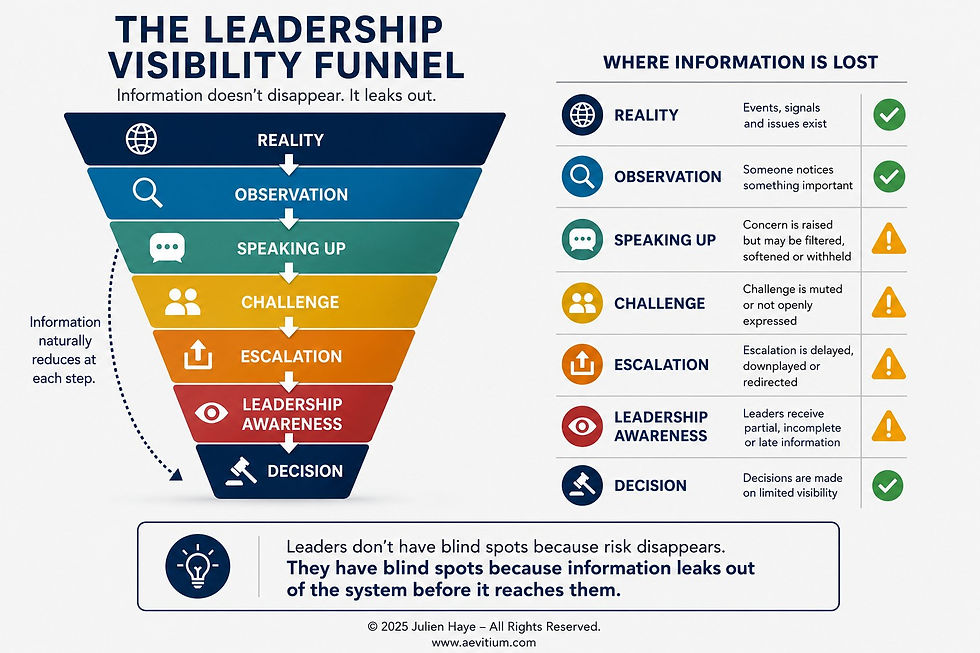
Leadership blind spots rarely arise because risks disappear. They develop because information is progressively filtered as it moves through an organisation. Every stage, from recognising an issue to escalating it, introduces opportunities for hesitation, reinterpretation, or silence. By the time information reaches senior leaders, it may no longer fully represent the reality experienced by those closest to the issue.
The Leadership Visibility Funnel illustrates where visibility is gradually lost and why psychological safety plays such a critical role in preserving the quality of information available for decision-making.
Gain deeper insight into how leadership signals shape risk outcomes with our Risk Leadership Diagnostics.
Common Blind Spots in Risk Leadership
Even the most experienced risk leaders are vulnerable to blind spots, not because of a lack of knowledge, but because of the very structures and habits that make us feel in control.
We build sophisticated frameworks, define clear responsibilities, and rely on data and reporting lines to give us confidence. But over time, these tools can create a false sense of certainty. We begin to trust the system more than we test the signals within it. When leaders over-rely on frameworks or signals without probing the underlying dynamics, they risk overlooking emerging threats or undervaluing unconventional thinking.
That’s why recognising and responding to uncertainty is a leadership skill rooted in the art of risk taking. By understanding the attributes that shape confident, informed risk decisions, leaders can build a culture that balances vigilance with adaptability.
These are some of the most common and overlooked blind spots in risk leadership. They are subtle patterns that, if left unchecked, erode challenge, reduce psychological safety, and weaken the very oversight we are trusted to uphold.
1. Confidence in the Framework Over the People
The controls look tight, the assurance maps are complete, and the reports are all green. But how often do we test the assumptions beneath them? Over-reliance on frameworks can mask the human behaviours that drive real risk.
Example: A global asset manager relied on its quarterly RCSA process to identify control gaps. On paper, everything passed. Yet a routine audit later uncovered that several key risk indicators were being manually manipulated to avoid triggering review. The system looked solid, but trust in the framework had replaced trust in the people using it.
2. The Culture Illusion
A few positive culture surveys and a low incident count do not guarantee psychological safety. Sometimes, the absence of escalation is not a sign of health, but of fear. When people do not feel safe to speak up, silence becomes a red flag.
Example: At a large financial institution, senior leadership celebrated a year with zero reported whistleblowing cases. They saw it as evidence of a strong culture. It later emerged that employees were sharing concerns informally or exiting quietly, believing formal reporting would jeopardise their careers.
Leadership blind spots become most difficult to recognise when silence stops being an individual choice and becomes an organisational norm.
Every organisation teaches people how challenge is expected to occur. Employees observe which concerns receive attention, which are deferred, and which disappear without discussion. Those observations gradually shape expectations about what is worth raising and when. Over time, the organisation develops informal rules that sit alongside its formal governance processes. These unwritten rules influence the flow of information just as powerfully as reporting lines or committee structures.
By the time leaders notice that challenge has diminished, the underlying behavioural patterns have often been reinforced over many interactions. Silence is no longer an exception. It has become part of how the organisation operates.
3. Delegation Without Listening Loops
Leaders often delegate risk ownership effectively but fail to create spaces where honest feedback flows back up. Without a structured way to receive unfiltered insights, upward communication is lost in translation or diluted by hierarchy.
Example: A Chief Risk Officer (CRO) at a European bank implemented a decentralised risk model. Ownership shifted to the business units, but no mechanisms were in place for those units to escalate concerns. When one team tried to raise an early warning about a vendor’s conduct, their feedback stalled three layers below senior leadership and was never acted upon.
4. Consensus as a Proxy for Alignment
When everyone agrees, it feels like progress. But agreement can be misleading when power dynamics are not openly addressed. Without genuine dissent, consensus often reflects compliance, not conviction.
Example: During a major strategic risk committee meeting, a decision to expand into a new market was approved unanimously. It later emerged that two team members had strong reservations but chose not to voice them, fearing they would appear uncooperative or out of step. The expansion failed, and so did the learning opportunity.
👉 Explore how an integrated risk framework can help reposition your risk function for greater influence.
Case Study: Credit Suisse and the Cost of Leadership Blind Spots
The collapse of Credit Suisse illustrates how leadership blind spots can develop even within mature risk management frameworks. The failure was not the result of a single unforeseen event. It reflected the cumulative effect of information, challenge, and decision-making becoming progressively disconnected over time.
The most visible example was the collapse of Archegos Capital Management in 2021, which resulted in losses of approximately US$5.5 billion for Credit Suisse. Independent investigations, including the Paul, Weiss report commissioned by the Board, concluded that repeated warning signs existed well before the event. Risk managers had identified growing concerns regarding counterparty exposure and concentration risk, yet governance arrangements did not consistently ensure that these concerns translated into timely executive decisions. Commercial priorities, fragmented accountability, and limited authority to challenge front-office decisions weakened the effectiveness of risk escalation before exposures became critical.
The contrast with several competitors is equally instructive. Institutions including Goldman Sachs and Morgan Stanley reduced their Archegos exposures significantly earlier, demonstrating that the underlying market information was available across the industry. The difference lay less in access to information than in how quickly concerns were challenged, escalated, and acted upon.
For risk leaders, the lesson extends well beyond a single financial institution. Leadership blind spots rarely develop because organisations lack data, reporting, or capable risk professionals. They emerge when information loses clarity, urgency, or influence as it moves through successive layers of management. By the time decisions reach senior leadership, the picture may already have been materially altered.
The Leadership Visibility Funnel illustrates this progression. The warning signs existed. The observations were made. The breakdown occurred as challenge, escalation, and leadership awareness became progressively weakened, allowing a known exposure to develop into a multi-billion-dollar loss.
Practical takeaway: Select a recent incident, near miss, or significant decision and trace how information travelled from the first observation to executive awareness. Identify where information was delayed, softened, reinterpreted, or failed to progress. The points where information quality changed often reveal the organisation's true leadership blind spots and highlight where psychological safety, challenge, or escalation processes require strengthening.
How to Tell When Something’s Missing
Here is what I often ask clients, and myself, when assessing the health of challenge in a risk function:
Do people regularly challenge my views or decisions in our risk forums? Real challenge is not a threat to leadership. It is a sign of trust. If everyone always agrees, are we truly debating risk, or just reporting it?
When was the last time we changed course because of challenge from the second or third line? If risk input never shifts the direction of travel, then it may be seen as background noise. Impactful challenge should be visible in the decisions we make, not just in the minutes we file.
Do staff speak more freely when I am not in the room? This is one of the clearest indicators of psychological safety. If voices only emerge in smaller groups or through informal channels, then the culture may not be as open as it appears.
Are most of our assurance findings "low impact" or are they low courage? A pattern of low-rated issues may reflect control strength. Or it may reflect reluctance to speak hard truths. When everything looks minor, we should question what is not being said.
These questions are not easy, and the answers are not always comfortable. But they reveal the true state of challenge in a risk function, and whether we are enabling dissent or simply assuming it exists.
Three Questions Before Every Executive Risk Meeting
Which issues have we discussed outside this meeting but not inside it?
Which assumptions have not been challenged?
Which voices have not been heard?
Leadership Self-Assessment: Identifying Your Own Blind Spots
Leadership blind spots rarely develop because leaders stop caring about risk. More often, they develop because changes in behaviour alter the quality of information flowing upwards.
Consider the following questions:
When was the last time someone openly challenged one of my assumptions during a meeting?
Which conversations seem to happen after the meeting rather than during it?
Have I recently been surprised by an issue that others appeared to know about?
Do people bring me problems early, or only once they have become difficult to ignore?
What behaviours might I unintentionally display that make challenge feel more difficult?
The purpose of these questions is not self-criticism. It is to recognise that leadership behaviour continuously shapes the conditions in which people decide whether to speak openly. The quality of challenge a leader receives is often a reflection of the environment they create, not simply the willingness of others to speak.
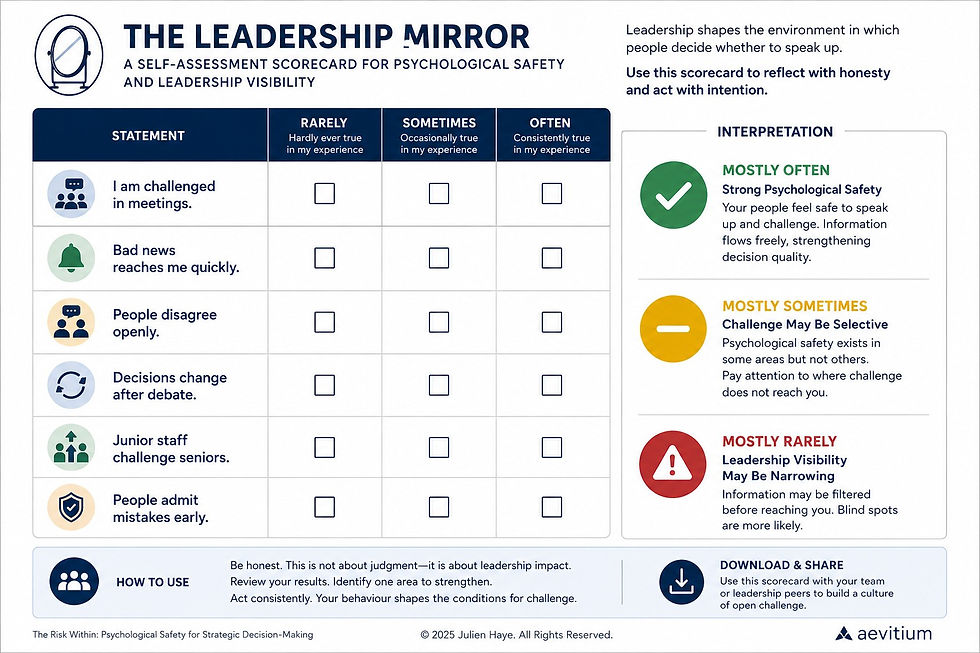
The Leadership Mirror: A Self-Assessment for Leadership Visibility
Understanding leadership blind spots is only the first step. The more difficult challenge is recognising whether they may already be developing within your own team.
The Leadership Mirror is a simple self-assessment designed to help leaders reflect on the quality of challenge, information flow and psychological safety around them. It does not measure organisational culture directly. Instead, it highlights behavioural signals that influence the quality of information leaders receive before making important decisions.
If several of these statements are rated Rarely, it may indicate that information is becoming progressively filtered before reaching senior leadership.
How to See What You Can’t See
You can’t eliminate blind spots, but you can shrink them. Here’s how:
Invite Real Challenge
Use pre-mortems and red teaming. Ask: What are we not seeing? Who disagrees with this? Make it a ritual, not a risk.
Measure Challenge, Not Just Compliance
Track how often challenge is raised — and acted upon — in your governance forums.
Introduce Upward Feedback Loops
Reverse mentoring, skip-level check-ins, and anonymous feedback can surface insights your direct reports won’t.
Be Vulnerable at the Top
When leaders model humility, curiosity, and admission of doubt, it creates space for others to speak up.
Appoint a Psychological Safety Champion in Risk
Not HR. Not the CEO. Someone inside the risk function who can hold the mirror up to your team culture.
📘 This evolution — from gatekeeper to enabler — is at the heart of the final chapter of The Risk Within. In it, I explore how the risk function can become a cultural and change agent by integrating more deeply into the business, expanding its focus to emerging risks, and actively shaping the conditions for psychological safety. A risk function that adapts in this way is not just managing threats — it’s enabling better decisions at every level.

Board Oversight Checklist
Five Questions Directors Should Ask About Leadership Visibility
1. How confident are we that the information reaching the Board accurately reflects operational reality?
Board reporting should provide more than assurance that controls are functioning. Directors should seek confidence that emerging concerns, operational pressures, and dissenting views are reaching senior leadership before they become material issues. The quality of decisions depends on the quality of information received.
2. Where in the organisation is information most likely to be filtered before it reaches senior leadership?
Information can be lost at multiple points, including speaking up, managerial challenge, escalation, committee reporting, and executive communication. Boards should understand where these potential bottlenecks exist and how they influence organisational visibility into emerging risks.
3. What evidence demonstrates that psychological safety exists beyond employee survey results?
Psychological safety is reflected in behaviour rather than perception alone. Directors should look for evidence that employees raise concerns early, challenge assumptions constructively, admit mistakes without fear of blame, and escalate issues before they become difficult to resolve.
4. How do leaders respond when uncomfortable information challenges prevailing assumptions?
Leadership behaviour establishes the conditions that shape future information flows. Boards should understand whether difficult conversations are welcomed, whether challenge influences decisions, and whether responses to bad news encourage continued openness rather than reinforcing silence.
5. How are leadership blind spots identified before they influence strategic decisions?
No organisation can eliminate uncertainty, but it can reduce the likelihood that important information fails to reach decision-makers. Directors should expect regular reflection on information quality, leadership visibility, and the behavioural conditions that enable constructive challenge, ensuring that governance arrangements support informed decision-making rather than simply comprehensive reporting.
Final Thought
In a world defined by complexity, uncertainty, and rapid change, risk leadership is as much frameworks and foresight as, and probably even more so, about humility and courage. It is about creating space for the unseen, the unspoken, and the uncomfortable truth to surface.
True leadership is not measured by how much risk you can see, but by how open you are to what you cannot see yet. That means inviting challenge, listening without defensiveness, and recognising that silence does not always signal agreement. Sometimes it signals fear.
The most dangerous risks are not always external. Some of the most significant threats to decision-making, culture, and resilience lie within our own assumptions, habits, and leadership behaviours.
The greatest quiet risk may be the one closest to you. The one in the mirror. The one that no one else feels safe enough to name.
It is time to bring that risk into the open.
>>> Addressing blind spots starts with building a culture where people feel safe to speak up, explored further in our breakdown of the Four Stages of Psychological Safety
About the Author: Julien Haye
Managing Director of Aevitium LTD and former Chief Risk Officer with over 26 years of experience in global financial services and non-profit organisations. Known for his pragmatic, people-first approach, Julien specialises in transforming risk and compliance into strategic enablers. He is the author of The Risk Within: Cultivating Psychological Safety for Strategic Decision-Making and hosts the RiskMasters podcast, where he shares insights from risk leaders and change makers.
Frequently Asked Questions
1. Can experienced leaders recognise their own leadership blind spots?
Not always. Leadership blind spots develop because leaders depend on information provided by others. As responsibility increases, direct visibility into operational reality often decreases. Regular challenge, diverse perspectives, and psychologically safe feedback help reduce the risk that important information is unintentionally filtered before reaching decision-makers.
2. What is the relationship between psychological safety and decision quality?
Psychological safety influences whether people share concerns, challenge assumptions, and escalate emerging risks early. When people feel comfortable speaking openly, leaders receive more complete and balanced information, improving the quality of strategic and operational decisions.
3. Can strong governance frameworks eliminate leadership blind spots?
No. Governance frameworks provide structure, accountability, and oversight, but they cannot guarantee that important information will be shared. Leadership behaviour, organisational culture, and psychological safety determine whether governance processes operate as intended in practice.
4. Why do organisations continue to be surprised by risks they were already aware of?
Many significant failures are preceded by warning signs that existed somewhere within the organisation. The challenge is often not identifying the risk, but ensuring observations are communicated, challenged, escalated, and acted upon before conditions deteriorate.
5. How often should leadership teams assess information flow and psychological safety?
Leadership visibility should be reviewed as part of ongoing governance rather than only after incidents or employee surveys. Regular reflection on information flow, challenge, escalation, and leadership behaviours helps organisations identify emerging blind spots before they affect strategic decision-making.