.png)

1. Why Risk Management Changes as FinTechs Scale
Building a successful FinTech requires more than developing innovative products and acquiring customers. As organisations grow, they face increasing regulatory expectations, operational complexity, and governance responsibilities. Risk management evolves from an informal leadership activity into a strategic capability that supports sustainable growth, investor confidence, and regulatory compliance.
In the earliest stages, founders often make most strategic and operational decisions directly. Communication is immediate, teams are small, and leaders maintain visibility across customers, technology, operations, and finance. This operating model enables rapid execution and innovation.
As the business expands, this model becomes increasingly difficult to sustain. New products, larger teams, third-party suppliers, international operations, and regulatory obligations introduce interconnected risks that can no longer be managed through individual oversight alone.
The challenge is not that growing FinTechs become poorly managed.
The challenge is that organisational complexity often increases faster than governance, decision-making, and risk management frameworks mature.
The most successful FinTechs recognise this transition early. They establish governance, operational resilience, and enterprise risk management before complexity begins to affect execution, customer outcomes, or regulatory confidence.
Founder-Led Decision Making Cannot Scale Indefinitely
During the start-up phase, founders typically approve strategic initiatives, resolve operational issues, oversee product development, engage with investors, and manage regulatory relationships.
This concentration of knowledge enables rapid decision-making and supports early growth.
However, founder-led governance becomes increasingly difficult as organisations scale. Decisions become distributed across multiple functions, new management layers emerge, and specialist expertise develops throughout the business. Without clearly defined governance structures, decision authorities, and accountability, organisations become dependent on individuals rather than resilient operating models.
A scalable FinTech requires governance that supports delegation without reducing oversight.
Key governance considerations:
-
Clearly defined decision authority
-
Documented governance structure
-
Executive accountability
-
Escalation pathways
-
Management information supporting informed decisions
Product Expansion Increases Operational Risk
Every new product increases operational complexity. Additional customer journeys introduce new operational processes, technology integrations, third-party suppliers, financial crime controls, regulatory obligations, and customer support requirements.
Individual products may perform effectively in isolation. The greatest operational risks often emerge where products, systems, and processes interact.
For example, launching embedded finance, digital wallets, Buy Now Pay Later services, or cross-border payment capabilities frequently requires changes across technology, compliance, operations, customer servicing, fraud prevention, and finance simultaneously.
As product portfolios expand, risk management shifts from evaluating individual risks towards understanding how risks interact across the organisation.
International Expansion Introduces Regulatory Complexity
Expanding into new jurisdictions changes both commercial opportunities and regulatory expectations.
Each market introduces its own supervisory framework, licensing requirements, operational resilience expectations, outsourcing rules, financial crime obligations, consumer protection requirements, and data privacy regulations. Examples include:
-
Financial Conduct Authority (FCA)
-
Digital Operational Resilience Act (DORA)
-
Payment Services Directive (PSD2/PSD3)
-
General Data Protection Regulation (GDPR)
-
Anti-Money Laundering (AML) regulations
International growth therefore requires governance models that provide consistent oversight while allowing local regulatory accountability. Successful FinTechs standardise governance principles while adapting operational implementation to local regulatory requirements.
Regulatory Authorisation Raises Expectations
Obtaining FCA authorisation or expanding regulatory permissions represents more than a compliance milestone. It demonstrates organisational maturity.
Regulators increasingly assess whether firms can demonstrate effective governance rather than simply producing compliant documentation. Areas of regulatory focus commonly include:
-
Board oversight
-
Risk governance
-
Operational resilience
-
Consumer Duty
-
Risk appetite
-
Outsourcing governance
-
Incident management
-
Internal controls
-
Senior management accountability
Regulatory confidence develops through consistent execution rather than policy documentation alone.
Regulatory Permissions Shape the Risk Management Framework
As a FinTech develops, its regulatory permissions can change alongside its products and business model. Moving into regulated activities, adding new payment services or expanding an existing permission can materially change the risks the organisation needs to manage and the governance expected around them.
For UK FinTechs and payment firms, this may include operating as an:
-
Account Information Service Provider (AISP)
-
Payment Initiation Service Provider (PISP)
-
Payment Institution (PI)
-
Electronic Money Institution (EMI)
These are not simply different regulatory labels. The activities a firm undertakes can affect requirements relating to governance, safeguarding, capital, financial crime, operational resilience, security, regulatory reporting and customer protection.
The risk management framework therefore needs to reflect both the firm's current regulatory perimeter and how its permissions may evolve as the business grows.
A firm beginning with account information services, for example, may later introduce payment initiation. A payment firm may expand into electronic money or additional payment services. Each development can introduce new regulatory obligations, operational dependencies and risks that need to be incorporated into governance and risk management.
Explore our practical guides to UK FinTech permissions:
→ AISP Authorisation: What FinTechs Need to Know
→ PISP Authorisation: A Practical Guide for Payment Firms
→ Payment Institution Authorisation in the UK
→ Electronic Money and EMI Authorisation
→ Comparing UK Financial Permissions
Operational Complexity Grows Exponentially
As FinTechs scale, organisational complexity rarely increases in a linear manner. Growth typically introduces:
-
More employees
-
More products
-
More technology platforms
-
More suppliers
-
More regulatory obligations
-
More customer segments
-
More operational dependencies
Each additional dependency creates new relationships across the organisation. Operational incidents increasingly arise through multiple interconnected events rather than isolated failures.
This is why enterprise risk management becomes increasingly important as organisations mature. It enables leadership to understand how technology, operations, third parties, regulatory obligations, cyber security, and customer outcomes influence one another.
Institutional Investors Assess Governance as Well as Growth
As FinTechs raise institutional funding, investors evaluate much more than revenue growth. Governance maturity has become an important indicator of execution capability. Investor due diligence increasingly examines:
-
Governance effectiveness
-
Board capability
-
Risk management maturity
-
Operational resilience
-
Regulatory readiness
-
Control environment
-
Decision-making discipline
-
Leadership capability
Strong governance provides confidence that future growth can be delivered sustainably without creating disproportionate operational or regulatory risk.
Board Expectations Continue to Evolve
Boards require different information as organisations mature. Early-stage reporting often focuses on financial performance, customer growth, and product delivery. As organisations scale, directors require broader visibility into:
-
Emerging risks
-
Strategic dependencies
-
Risk appetite
-
Operational resilience
-
Regulatory developments
-
Key Risk Indicators (KRIs)
-
Control effectiveness
-
Scenario analysis
-
Material third-party dependencies
Modern boards increasingly expect risk reporting to support strategic decision-making rather than simply describe historical events. Effective enterprise risk management enables boards to understand whether organisational resilience is strengthening as the business grows.

2. The Cost of Scaling Without a FinTech Risk Management Framework
A FinTech risk management framework provides the governance, decision-making, processes, and controls required to identify, assess, monitor, and manage risk as an organisation grows. It enables leadership teams to balance innovation with regulatory compliance, operational resilience, and sustainable business performance.
Many FinTechs operate successfully without a formal framework during their earliest stages. Small teams communicate directly, founders maintain oversight of key decisions, and emerging issues can often be resolved quickly through informal collaboration.
This operating model becomes increasingly difficult to sustain as the organisation scales.
New products, larger teams, additional suppliers, international expansion, and increasing regulatory obligations create interconnected risks that can no longer be managed through individual oversight alone. The challenge is rarely a lack of commitment to good governance. More often, organisational complexity begins to outpace governance maturity.
The consequences extend well beyond regulatory compliance. They influence decision quality, operational efficiency, investor confidence, customer outcomes, and the organisation's ability to scale successfully.
Why Governance Becomes More Difficult as FinTechs Scale
Growth introduces new layers of organisational complexity.
Leadership teams recruit specialists, expand into new markets, develop additional products, onboard strategic suppliers, and respond to increasing regulatory expectations. Decisions that were previously made by a small executive team become distributed across technology, operations, product, compliance, finance, legal, and commercial functions.
Without a clearly defined governance structure, organisations often experience inconsistent decision-making, duplicated effort, and increasing operational risk.
An effective enterprise risk management framework creates common decision standards, clarifies accountability, and ensures that strategic priorities remain aligned across the organisation.
Inconsistent Decision-Making Reduces Organisational Agility
One of the earliest indicators of governance strain is inconsistency.
Different business functions begin interpreting the organisation's risk appetite differently. Product teams may prioritise speed to market, while compliance, operations, or technology teams apply different thresholds for acceptable risk.
The result is uncertainty rather than agility. Projects require repeated review, executive escalations increase, and similar decisions produce different outcomes depending on who is involved.
A mature governance framework establishes consistent decision principles, defined approval authorities, and clear escalation criteria. This improves both decision quality and execution speed.
Weak Governance Creates Regulatory Risk
As FinTechs mature, regulatory expectations evolve. The Financial Conduct Authority (FCA) increasingly assesses how governance operates in practice rather than whether policies exist. Supervisory activity commonly examines governance arrangements, operational resilience, Consumer Duty, outsourcing oversight, senior management accountability, and the effectiveness of risk management frameworks.
Regulatory findings frequently arise where firms cannot demonstrate:
-
Clear ownership of material risks
-
Effective board oversight
-
Meaningful management information
-
Consistent application of risk appetite
-
Effective operational resilience arrangements
-
Timely escalation of significant issues
Regulatory confidence is built through effective execution rather than documentation alone.
Operational Complexity Increases Operational Risk
Operational risk changes as FinTechs grow. Early-stage organisations often experience isolated operational issues. As businesses mature, incidents increasingly arise through the interaction of multiple systems, suppliers, technologies, regulatory obligations, and business processes.
For example, a technology outage may simultaneously affect customer onboarding, payment processing, fraud monitoring, regulatory reporting, and customer communications. Similarly, a third-party service disruption can trigger operational resilience obligations, contractual issues, customer complaints, and regulatory notifications.
Operational resilience therefore requires organisations to understand how important business services depend on interconnected operational capabilities rather than individual functions operating independently.
Fragmented Governance Creates Inefficiency
Rapid growth frequently results in governance developing organically rather than strategically. Additional committees are introduced to oversee new initiatives. Reporting forums evolve independently across functions. Control activities expand as individual teams respond to local challenges.
Although each change may appear reasonable in isolation, the cumulative effect is often fragmented governance. Common symptoms include:
-
Duplicated controls
-
Multiple reviews of the same issue
-
Unclear decision ownership
-
Inconsistent reporting
-
Delayed escalation
-
Increased management overhead
An integrated risk management framework simplifies governance by aligning accountability, reporting, and assurance across the organisation.
Investors Assess Governance Alongside Financial Performance
Institutional investors increasingly view governance maturity as an indicator of execution capability. During investment rounds, due diligence commonly extends beyond financial performance to evaluate whether leadership has established effective governance, operational resilience, board oversight, and enterprise risk management. Typical questions include:
-
Can the organisation scale without increasing operational risk?
-
Does leadership understand its principal risks?
-
Is governance appropriate for future growth?
-
Can regulatory expectations continue to be met?
-
Does management receive reliable risk information to support strategic decisions?
Weak Governance Slows Innovation
Risk management is often perceived as slowing product development. In practice, the opposite is frequently true. Where governance is poorly defined, product launches encounter repeated reviews because ownership, approval criteria, and regulatory requirements have not been established early in the development process.
Compliance concerns emerge late. Technology dependencies are identified after implementation has started. Operational risks require redesign immediately before launch. Mature FinTechs integrate risk management, compliance, operational resilience, and product governance into product development from the outset. This enables issues to be identified earlier, reduces rework, and supports faster, more predictable delivery.
Effective governance therefore accelerates innovation rather than restricting it.

3. Building a Scalable FinTech Risk Management Framework
A FinTech risk management framework provides the governance, structure, and decision-making capability required to support sustainable growth. It enables organisations to identify emerging risks, allocate accountability, monitor operational performance, satisfy regulatory expectations, and make informed decisions as complexity increases.
For early-stage businesses, informal governance may be sufficient. Leadership teams often communicate directly, founders retain visibility across operations, and decisions can be implemented rapidly. As organisations scale, however, this model becomes increasingly difficult to sustain. Multiple products, expanding technology platforms, additional jurisdictions, third-party providers, and larger workforces create interconnected risks that require a more structured approach.
An effective risk management framework should not introduce unnecessary bureaucracy. It should provide leadership with the information, governance, and assurance required to make better decisions without slowing innovation. The strongest FinTechs recognise that governance is not separate from growth. It is one of the capabilities that enables growth.
Listen to our podcast episode to learn more: CPD EP3 Fintech's Risk Frontier: A Conversation with Divya Eapen on RiskMasters
What Should a FinTech Risk Management Framework Include?
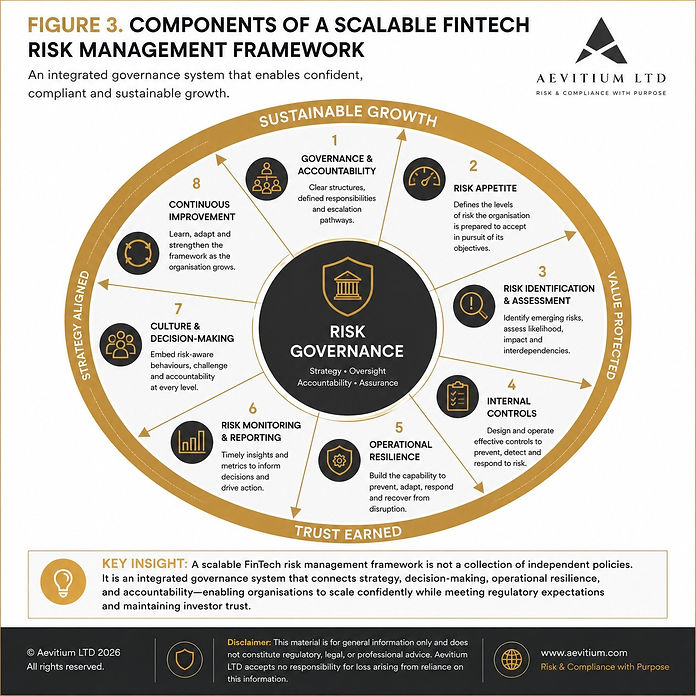
Although every organisation differs, mature enterprise risk management frameworks typically incorporate eight interconnected components. Each component supports a different aspect of governance while contributing to a single objective: enabling informed decision-making under increasing complexity.
1. Governance and Accountability
Governance establishes how decisions are made, who owns them, and how accountability is maintained throughout the organisation. A clear governance structure enables executives and boards to understand where decisions should be taken, when issues require escalation, and how oversight supports strategic objectives. Key governance elements include:
-
Board oversight
-
Executive committees
-
Clearly defined decision authorities
-
Senior management accountability
-
Escalation pathways
-
Committee terms of reference
-
Three Lines Model
-
Management information
2. Risk Appetite
A risk appetite framework translates strategy into practical decision-making. Rather than describing acceptable levels of risk in abstract terms, it provides leadership with clear boundaries for commercial, operational, regulatory, financial, cyber, and reputational decisions. Risk appetite should influence:
-
Product approvals
-
Customer acceptance
-
Outsourcing decisions
-
Technology investment
-
Operational resilience
-
Regulatory compliance
-
Strategic growth initiatives
3. Risk Identification and Assessment
Risk identification should be continuous rather than periodic. Growing FinTechs operate in environments where technology, regulation, customer expectations, cyber threats, and competitive pressures evolve rapidly. Risk assessments should therefore identify emerging threats before they become operational issues.
Typical categories include:
-
Operational risk
-
Cyber security
-
Technology risk
-
Financial crime
-
Fraud
-
Third-party risk
-
Regulatory risk
-
Conduct risk
-
Data protection
-
Strategic risk
Assessment should consider:
-
Likelihood
-
Impact
-
Velocity
-
Interconnectivity
-
Customer outcomes
-
Regulatory consequences
Enterprise risk management enables leadership to understand not only individual risks but also how risks interact across the organisation.
4. Internal Controls
Controls reduce the likelihood and impact of operational failures. An effective control framework balances efficiency with assurance by ensuring that preventive, detective, and corrective controls operate consistently across business processes. Typical control categories include:
-
Policy controls
-
System controls
-
Segregation of duties
-
Automated monitoring
-
Reconciliations
-
Access management
-
Incident response
-
Quality assurance
Control effectiveness should be reviewed regularly as products, technologies, and operating models evolve.
5. Operational Resilience
Operational resilience has become a strategic capability for regulated FinTechs. Rather than focusing solely on preventing disruption, operational resilience prepares organisations to continue delivering important business services during periods of operational stress. Key capabilities include:
-
Important Business Services
-
Impact tolerances
-
Scenario testing
-
Business continuity planning
-
Crisis management
-
Third-party resilience
-
Incident management
-
Recovery planning
Operational resilience strengthens customer confidence while supporting regulatory expectations under the FCA and other supervisory authorities.
Learn More About Aevitium's Operational Resilience Maturity Assessment
Operational resilience begins with understanding your current capability. Aevitium's Operational Resilience Maturity Assessment benchmarks your organisation across eight core resilience capabilities, providing a clear view of your strengths, identifying priority improvement areas and helping you develop a practical roadmap for continuous enhancement.
Whether you are preparing for regulatory scrutiny, strengthening operational resilience, or planning future growth, our assessment delivers practical, proportionate insights tailored to your organisation's maturity and operating model.

6. Risk Monitoring and Reporting
Leadership requires timely information to support effective governance. Risk reporting should provide insight rather than simply present historical data. Typical reporting includes:
-
Key Risk Indicators (KRIs)
-
Operational incidents
-
Control effectiveness
-
Emerging risks
-
Regulatory developments
-
Operational resilience metrics
-
Third-party performance
-
Management actions
Boards increasingly expect reporting that supports forward-looking decisions rather than retrospective analysis
.
7. Culture and Decision-Making
Every governance framework ultimately depends on organisational behaviour. Policies define expectations. People determine how consistently those expectations are applied. Healthy risk cultures encourage:
-
Constructive challenge
-
Transparent escalation
-
Cross-functional collaboration
-
Learning from incidents
-
Clear ownership
-
Accountability
-
Informed decision-making
8. Continuous Improvement
Risk management frameworks should evolve alongside the organisation. Changes in products, markets, regulation, technology, customer expectations, and organisational strategy require regular review of governance arrangements. Continuous improvement typically includes:
-
Internal assurance
-
Lessons learned reviews
-
Scenario testing
-
Regulatory change monitoring
-
Framework reviews
-
Risk appetite review
-
Control optimisation
-
Board effectiveness assessments
4. What Regulators and Investors Expect from a Scaling FinTech
As FinTechs scale, governance is no longer assessed solely by internal stakeholders. Regulators, institutional investors, strategic partners, and enterprise customers increasingly evaluate whether the organisation can manage growth safely and sustainably.
For many FinTechs, governance maturity becomes a competitive advantage.
A robust FinTech risk management framework demonstrates that leadership understands the organisation's principal risks, has established effective oversight, and can continue to scale while maintaining operational resilience, regulatory compliance, and customer confidence.
Although regulators and investors assess organisations from different perspectives, both are seeking evidence of the same underlying capability: disciplined decision-making supported by effective governance.
What Does the FCA Expect from a FinTech Risk Management Framework?
The Financial Conduct Authority (FCA) expects authorised firms to demonstrate that risk management is embedded within governance rather than operating as a standalone compliance function. Supervisory reviews increasingly focus on how organisations identify, assess, manage, monitor, and report risks as part of everyday decision-making. The emphasis is not simply on having policies. It is on demonstrating that governance operates effectively in practice. Areas commonly examined include:
-
Board oversight and governance
-
Senior management accountability
-
Enterprise risk management
-
Operational resilience
-
Consumer Duty
-
Outsourcing and third-party risk management
-
Incident management and escalation
-
Management information and board reporting
-
Internal controls
-
Risk culture and decision-making
Governance Must Be Evidenced, Not Documented
One of the most common misconceptions is that governance is demonstrated through documentation. Policies, procedures, committee terms of reference, and governance frameworks are important. However, regulators increasingly seek evidence that these arrangements influence operational behaviour and strategic decisions. For example:
-
Does the Board receive meaningful risk information?
-
Are significant risks escalated promptly?
-
Does risk appetite influence commercial decisions?
-
Are Important Business Services regularly reviewed?
-
Are operational incidents analysed to improve resilience?
-
Is accountability clearly understood across the organisation?
Operational Resilience Has Become a Core Governance Capability
Operational resilience has become a fundamental component of risk management for regulated FinTechs. The focus is no longer limited to preventing disruption. Leadership must demonstrate that important business services can continue within defined impact tolerances during operational disruption. This requires organisations to understand:
-
Critical business services
-
Supporting technology
-
Third-party dependencies
-
Operational processes
-
Recovery capabilities
-
Customer impacts
Investors Assess Governance as an Indicator of Execution Capability
Institutional investors increasingly evaluate governance alongside financial performance. Strong commercial growth alone provides limited assurance that an organisation can continue scaling successfully. During investment rounds and due diligence, investors frequently assess whether governance has matured alongside business growth. Areas commonly reviewed include:
-
Board effectiveness
-
Executive capability
-
Risk governance
-
Operational resilience
-
Internal controls
-
Regulatory readiness
-
Financial crime governance
-
Third-party oversight
-
Decision-making discipline
These assessments help investors determine whether the organisation can execute its strategy without introducing disproportionate operational or regulatory risk. Governance maturity therefore becomes an important indicator of long-term enterprise value.
Enterprise Customers Expect Robust Governance
For many FinTechs, large enterprise customers conduct extensive supplier due diligence before entering commercial relationships. These assessments increasingly examine governance arrangements alongside technology capabilities. Prospective customers often request evidence relating to:
-
Risk management frameworks
-
Information security governance
-
Operational resilience
-
Business continuity
-
Incident management
-
Third-party risk management
-
Regulatory compliance
-
Internal controls
Organisations with mature governance frameworks can respond more efficiently to due diligence requests while strengthening customer confidence. Governance therefore supports commercial growth as well as regulatory compliance.
Governance Creates Competitive Advantage
Many organisations continue to view governance primarily as a regulatory obligation. The most successful FinTechs adopt a different perspective. They recognise that governance improves decision quality, strengthens investor confidence, accelerates customer due diligence, supports regulatory engagement, and enables sustainable growth.
As organisational complexity increases, governance becomes one of the capabilities that distinguishes businesses able to scale confidently from those that struggle to maintain control. Effective governance therefore creates strategic advantage rather than administrative overhead.

5. Operational Resilience as a Competitive Advantage
Many organisations view operational resilience as a regulatory requirement.
The most successful FinTechs view it differently.
They recognise operational resilience as a strategic capability that enables the organisation to continue delivering critical services during disruption, maintain customer confidence, satisfy regulatory expectations, and support sustainable growth.
A strong FinTech risk management framework identifies and manages risk.
Operational resilience demonstrates whether that framework can continue to operate effectively when disruption occurs.
Together, they provide leadership with confidence that the organisation can respond, recover, and adapt without compromising important business services or customer outcomes.
Rather than operating as a separate programme, operational resilience strengthens governance by connecting strategic decision-making, risk management, technology, third-party oversight, and business continuity into a single operating model.
Important Business Services: Protecting What Matters Most
Operational resilience begins by identifying the Important Business Services (IBSs) that are essential to customers, markets, and the organisation. Rather than attempting to protect every individual process equally, organisations focus resources on the services whose disruption would cause intolerable harm.
For many FinTechs, Important Business Services may include:
-
Payment processing
-
Customer onboarding
-
Digital account access
-
Fraud monitoring
-
Transaction settlement
-
Customer authentication
-
Safeguarding of client funds
Impact Tolerances Define Acceptable Levels of Disruption
No organisation can eliminate operational disruption entirely. Instead, resilient organisations define impact tolerances that establish the maximum level of disruption that customers, markets, or the business can reasonably withstand before unacceptable harm occurs. Impact tolerances help leadership answer critical questions:
-
How long can an Important Business Service be unavailable?
-
How many customers could be affected before intervention is required?
-
At what point does operational disruption become a regulatory issue?
-
When should executive escalation occur?
Scenario Testing Strengthens Decision-Making
Policies and documentation provide limited assurance that resilience arrangements will operate effectively during a real incident. Scenario testing allows organisations to evaluate how governance, technology, people, suppliers, and decision-making perform under realistic conditions. Effective exercises should assess more than technical recovery.
They should examine:
-
Executive decision-making
-
Crisis management
-
Cross-functional coordination
-
Communication with customers and regulators
-
Escalation effectiveness
-
Recovery capabilities
-
Lessons learned
Third-Party Resilience Extends Beyond Supplier Due Diligence
Modern FinTechs depend extensively on cloud providers, payment processors, technology platforms, outsourced service providers, and other strategic partners. As a result, organisational resilience increasingly depends on the resilience of the wider supply chain. Effective third-party risk management extends beyond contractual oversight. Leadership should understand:
-
Critical supplier dependencies
-
Concentration risk
-
Recovery capabilities
-
Exit strategies
-
Sub-outsourcing arrangements
-
Service resilience under disruption
Strengthening third-party resilience reduces the likelihood that external failures become enterprise-wide operational incidents.
Incident Management and Recovery Planning Enable Faster Recovery
Operational resilience is measured not by whether incidents occur, but by how effectively organisations respond when they do. An effective incident management framework enables leadership to identify disruptions quickly, coordinate cross-functional responses, communicate effectively with stakeholders, and restore important business services within agreed impact tolerances. Recovery planning should therefore include:
-
Clearly defined incident governance
-
Executive decision authority
-
Crisis communication procedures
-
Technology recovery arrangements
-
Business continuity plans
-
Regulatory notification processes
-
Post-incident reviews and continuous improvement
Every incident should strengthen organisational resilience by informing future governance, controls, and recovery capability.
Operational Resilience Supports Sustainable Growth
As FinTechs scale, operational resilience becomes more than a regulatory obligation. It enables organisations to launch new products with greater confidence, strengthen customer trust, respond more effectively to disruption, and demonstrate governance maturity to regulators, investors, and enterprise customers.
Organisations that integrate operational resilience into their broader risk management framework are better positioned to scale without compromising service delivery or customer outcomes.
Operational resilience therefore becomes a source of competitive advantage rather than a compliance exercise.
Key Takeaways
-
Operational resilience complements enterprise risk management by ensuring critical services remain available during disruption.
-
Important Business Services help organisations prioritise governance and investment where disruption would have the greatest impact.
-
Impact tolerances establish clear thresholds for decision-making and executive escalation.
-
Scenario testing validates governance, operational processes, and recovery capabilities under realistic conditions.
-
Third-party resilience and effective incident management are essential for maintaining customer confidence in increasingly interconnected operating environments.
6. Why Scaling FinTechs Struggle to Embed Risk Management
Building a FinTech risk management framework is a significant milestone. Embedding that framework into the organisation is considerably more challenging. Many scaling FinTechs invest substantial time developing governance documents, policies, and reporting structures. Yet operational incidents continue to occur, decision-making remains inconsistent, and regulators identify weaknesses in governance execution rather than governance design.
The difference between high-performing organisations and those that struggle rarely lies in the quality of their documentation. It lies in how effectively governance is translated into everyday decision-making. The following challenges frequently prevent risk management frameworks from delivering their intended value.
Prioritising Compliance Before Governance
As regulatory obligations increase, many FinTechs expand their compliance capability before establishing a coherent governance framework. This often results in organisations that produce compliant documentation but lack clear decision-making structures, defined accountability, or consistent executive oversight.
Compliance explains what regulatory requirements must be satisfied.
Governance determines how decisions are made to satisfy them.
Without effective governance, compliance activities become reactive rather than strategic. Successful organisations establish governance first, allowing compliance to operate within a clearly defined decision-making framework.
Treating Risk Management as Documentation
Another common misconception is that risk management is primarily about producing policies, risk registers, and committee papers.
These documents remain important. However, they do not reduce risk by themselves.
A mature enterprise risk management framework influences how products are approved, suppliers are selected, incidents are managed, technology changes are implemented, and strategic decisions are made.
Governance should therefore be visible through organisational behaviour rather than documentation alone.
Waiting Too Long to Formalise Governance
Informal governance often works well during the earliest stages of growth. Founders maintain visibility across operations, communication is immediate, and decisions can be implemented quickly.
As organisations expand, however, complexity increases far more rapidly than leadership visibility. Introducing governance only after operational problems emerge frequently leads to costly remediation programmes, increased regulatory scrutiny, and delayed strategic initiatives.
Governance is most effective when it evolves alongside business growth rather than responding to operational failures.
Overengineering Governance Too Early
The opposite challenge also occurs.
Some organisations introduce governance structures designed for significantly larger institutions. Multiple committees, excessive reporting, unnecessary approvals, and highly detailed policies can reduce organisational agility without improving risk management.
Effective governance should be proportionate.
A scalable framework grows with the organisation, providing sufficient oversight while allowing innovation and commercial execution to continue at pace.
Confusing Internal Audit with Risk Management
Risk management and internal audit perform complementary but fundamentally different roles.
Risk management helps leadership identify, assess, and manage uncertainty while supporting informed decision-making.
Internal audit provides independent assurance that governance, risk management, and internal controls are operating effectively.
Confusing these responsibilities often results in assurance activities replacing proactive risk management.
Strong governance recognises that risk ownership remains with management, while independent assurance strengthens accountability.
Treating Operational Resilience as a Compliance Exercise
Many organisations continue to view operational resilience as a regulatory programme rather than an organisational capability.
As a result, Important Business Services are documented, impact tolerances are defined, and scenario testing is completed primarily to satisfy supervisory expectations.
Operational resilience creates far greater value when integrated into strategic planning, product development, technology investment, supplier oversight, and crisis management.
Organisations that embed resilience into everyday decision-making are generally better prepared to manage disruption while maintaining customer confidence.
Weak Board Reporting Limits Effective Oversight
Boards cannot govern effectively without meaningful information. Reporting that focuses primarily on historical incidents, lengthy operational updates, or compliance activities often provides limited insight into the organisation's changing risk profile.
Effective board reporting should enable directors to understand:
-
Whether the organisation remains within risk appetite
-
Emerging strategic and operational risks
-
Trends affecting operational resilience
-
Significant third-party dependencies
-
Control effectiveness
-
Decisions requiring Board attention
Good reporting supports governance by improving the quality of strategic oversight rather than increasing the volume of information.
Risk Ownership Remaining with Founders
One of the final stages of governance maturity occurs when accountability moves beyond the founding leadership team.
As organisations scale, risk ownership should progressively transfer to executive leaders responsible for products, operations, technology, customer outcomes, and commercial performance.
This transition enables governance to become embedded throughout the organisation rather than remaining concentrated within a small group of individuals.
Boards increasingly expect executive teams to demonstrate ownership of risks within their areas of responsibility while maintaining enterprise-wide coordination through a common governance framework.
Governance Maturity Is a Competitive Advantage
Many governance failures do not arise because organisations lack expertise or commitment.
They occur because governance fails to mature at the same pace as organisational complexity.
The strongest FinTechs recognise that governance is not something introduced once growth has been achieved.
It is one of the capabilities that makes sustainable growth possible.
By embedding governance, enterprise risk management, operational resilience, and accountability into everyday decision-making, organisations improve execution, strengthen regulatory confidence, enhance investor assurance, and create a more resilient foundation for long-term success.
Call to Action
Is Your Risk Management Framework Ready to Scale?
Growth places increasing demands on governance, operational resilience, and executive decision-making. Whether you are preparing for FCA authorisation, expanding internationally, or strengthening investor confidence, the effectiveness of your risk management framework can become a critical differentiator.
Aevitium helps FinTechs design, embed, and mature scalable governance and enterprise risk management frameworks that support sustainable growth without unnecessary complexity.
Book a FinTech Risk Strategy Consultation to assess your current governance maturity and identify practical opportunities to strengthen decision-making, operational resilience, and regulatory readiness before complexity becomes a constraint on growth.
7. When Should a FinTech Hire a Chief Risk Officer?
There is no single point at which every FinTech needs a Chief Risk Officer (CRO). The need for dedicated risk leadership depends less on organisational size than on increasing complexity.
During the early stages of growth, founders and senior executives often have sufficient visibility to oversee governance and risk management directly. As the business expands, however, new products, regulatory obligations, operational dependencies, and stakeholder expectations make founder-led oversight increasingly difficult to sustain.
Typical indicators that governance needs to evolve include:
-
Preparing for FCA, Payment Institution (PI) or Electronic Money Institution (EMI) authorisation
-
Raising Series A or Series B investment
-
Expanding into new jurisdictions
-
Launching multiple products or services
-
Establishing a formal Board or appointing independent Non-Executive Directors
-
Growing headcount and distributing decision-making across multiple teams
-
Winning enterprise customers with more demanding governance and due diligence requirements
Reaching one or more of these milestones does not necessarily mean a FinTech needs a permanent Chief Risk Officer.
It does indicate that governance is becoming more complex.
As organisations scale, every function manages risk within its own area of responsibility. Technology manages platform resilience. Compliance manages regulatory obligations. Operations oversee service delivery. Product teams focus on innovation and customer outcomes.
The challenge is that many of the most significant risks no longer sit within individual functions. They emerge where decisions, processes, technologies, and responsibilities intersect.
Effective risk leadership provides an enterprise-wide perspective, helping leadership understand how decisions made across different functions combine to affect the organisation as a whole. It strengthens governance, improves decision-making, and ensures growth is supported by an appropriate level of oversight.
For many scaling FinTechs, this capability does not require a permanent executive appointment. A Fractional Chief Risk Officer can provide experienced, board-level risk leadership, independent challenge, and regulatory expertise on a flexible basis, enabling governance to mature alongside the organisation without introducing unnecessary cost or organisational complexity.
Is It Time to Strengthen Your Risk Leadership?
If your FinTech is approaching one or more of these milestones, it may be time to review whether your governance arrangements are keeping pace with your growth.

8. A Practical Roadmap for Building a Scalable Risk Management Framework
Building a scalable risk management framework is not about implementing every governance process at once. The most effective organisations strengthen governance progressively, ensuring it evolves alongside the business rather than becoming a reactive response to growth or regulatory pressure.
The following roadmap provides a practical approach to developing governance capability at each stage of a FinTech's growth.

9. Case Study - Fractional Risk Leadership for an AISP Business
Challenge
A rapidly growing UK payments business required experienced executive-level risk and compliance leadership to support its expansion, regulatory engagement and governance maturity without the cost of recruiting a full-time Chief Risk & Compliance Officer.
As the organisation developed new products, onboarded strategic partners and expanded its operations, it needed to strengthen governance, manage increasingly complex operational risks and demonstrate robust oversight to regulators and commercial partners while maintaining commercial agility.
The objective was not simply to implement risk frameworks, but to build governance capability that would enable sustainable growth.
Approach
Aevitium was appointed as Fractional Chief Risk & Compliance Officer, becoming an embedded member of the executive leadership team.
Working alongside the CEO and senior management, Aevitium provided strategic risk leadership focused on building a proportionate governance capability that evolved with the business. The engagement included:
-
Designing and embedding the enterprise risk management framework.
-
Establishing governance structures, executive and Board reporting.
-
Designing the Risk Appetite Framework and associated monitoring.
-
Leading the risk and compliance workstream supporting AISP Agent registration, including regulatory submissions and responses to FCA feedback.
-
Establishing operational resilience, incident management and business continuity capabilities.
-
Providing independent risk oversight for new products, partnerships and strategic initiatives.
-
Leading governance and executive coordination during significant operational incidents and fraud investigations.
This approach provided continuous executive-level leadership while allowing the organisation to scale without establishing a permanent executive risk function.
Outcomes
The engagement delivered measurable business outcomes, including:
-
Led the successful AISP Agent registration programme, designing the risk and compliance framework, preparing regulatory documentation and coordinating responses to FCA feedback, resulting in approval within approximately six months.
-
Designed and embedded the organisation's first enterprise-wide risk management framework, establishing clear governance, accountability and executive oversight across the business.
-
Transformed Board risk reporting by introducing structured, forward-looking reporting, providing leadership with regular insight into strategic, operational and emerging risks.
-
Designed and implemented a Risk Appetite Framework aligned with the organisation's strategy, enabling consistent and informed risk-based decision-making.
-
Directed the governance response to multiple fraud investigations, ensuring timely assessment, executive escalation, customer protection and control enhancements.
-
Led the executive response to a material end-to-end payment processing incident involving multiple external parties, coordinating investigation, governance oversight, root cause analysis and implementation of corrective actions.
-
Established operational resilience, incident management and business continuity capabilities proportionate to the organisation's size, operating model and growth ambitions.
-
Embedded independent risk oversight into product development, commercial initiatives and strategic decision-making, enabling innovation while maintaining effective governance.
Business Impact
During the engagement, the organisation successfully expanded its products, customer proposition and strategic partnerships while maintaining governance proportionate to its size and risk profile.
By accessing executive-level risk leadership on a fractional basis, the business avoided the cost of building a permanent Chief Risk & Compliance function while benefiting from experienced strategic oversight throughout a critical stage of growth.
Despite operating in a payments environment characterised by fraud, operational dependencies and third-party risk, the organisation experienced only one loss-making operational incident during the past twelve months. Significant fraud cases and a material payment processing incident were effectively managed through structured governance, executive oversight and coordinated remediation, minimising customer and business impact.
The engagement enabled the organisation to:
-
Achieve regulatory approval efficiently without creating a permanent executive risk function.
-
Scale governance in line with business growth while containing regulatory and risk management costs.
-
Strengthen Board oversight and executive decision-making through structured risk reporting and risk appetite.
-
Respond effectively to operational incidents and fraud events, protecting customers, partners and the business.
-
Build a governance capability capable of supporting future commercial expansion and increasing regulatory expectations.
Value Delivered
Aevitium's fractional leadership model provided the organisation with experienced executive-level risk and compliance capability precisely when it was needed. Rather than acting solely as an adviser, the Fractional Chief Risk & Compliance Officer became an extension of the executive team, enabling the organisation to strengthen governance, navigate regulatory milestones, manage complex operational events and scale with confidence, without the ongoing cost and commitment of a permanent executive appointment.
Frequently Asked Questions
How is a fractional Chief Risk Officer different from a consultant?
A consultant is typically engaged to deliver a defined project or provide specialist advice over a fixed period. A fractional Chief Risk Officer becomes part of your leadership team, providing ongoing executive oversight, supporting strategic decisions, attending governance meetings and taking ownership of the risk management agenda. The focus is on building long-term capability rather than delivering individual pieces of work.
When is the right time to appoint a fractional Chief Risk Officer?
Many organisations benefit from fractional risk leadership before they require a full-time executive. Common triggers include rapid growth, preparing for regulatory authorisation, increasing operational complexity, expanding into new markets, responding to investor or Board expectations, or strengthening governance following an incident.
Which organisations benefit most from fractional risk leadership?
Fractional risk leadership is particularly valuable for fintechs, payment firms, regulated financial services businesses, charities, scale-ups and organisations undergoing significant change. It is designed for organisations that require executive-level expertise without the ongoing cost of a permanent Chief Risk Officer.
Can a fractional Chief Risk Officer support regulatory engagement?
Yes. A fractional Chief Risk Officer can support regulatory applications, supervisory interactions, remediation programmes and governance reviews. This includes preparing documentation, responding to regulatory feedback, strengthening governance arrangements and helping leadership demonstrate effective oversight.
Will you work alongside our existing compliance or risk team?
Absolutely. The role is designed to complement existing resources rather than replace them. Depending on your organisation, we may provide strategic leadership to an internal team, coach developing risk professionals or work directly with operational leaders to embed effective risk management.
How much time does a fractional Chief Risk Officer typically spend with an organisation?
The level of support is tailored to your needs. Some organisations require only one or two days per month for governance oversight, while others need more intensive support during periods of growth, regulatory change, transformation or incident response. The engagement can scale as your organisation evolves.
Can you help if we already have a risk framework?
Yes. Many organisations already have policies and frameworks but require support to ensure they are practical, proportionate and embedded into decision-making. We regularly review, enhance and simplify existing governance arrangements to improve effectiveness rather than simply adding new documentation.
How do you measure the success of a fractional engagement?
Success is measured by business outcomes rather than the number of documents produced. Examples include stronger Board reporting, improved governance maturity, successful regulatory milestones, more effective operational resilience, better executive decision-making, reduced control weaknesses and a governance framework capable of supporting sustainable growth.
Can a fractional Chief Risk Officer support the Board as well as management?
Yes. The role often includes supporting Boards and Board Committees through independent reporting, risk oversight, governance advice, risk appetite reviews and strategic challenge, while also working closely with executive management to embed effective risk management across the organisation.
What happens if our organisation eventually needs a full-time Chief Risk Officer?
Fractional leadership is often used as a stepping stone. We can help build the governance framework, establish the function, recruit a permanent Chief Risk Officer if required and support a structured handover to ensure continuity.