
Operational Resilience as a Strategic Advantage: The Board and CRO Perspective

Updated: 2 days ago
Introduction: When Operational Resilience Becomes a Leadership Test
Organisations have invested considerable resources in strengthening operational resilience. Governance frameworks have matured, critical dependencies have been mapped, scenario testing has expanded and recovery arrangements have become more sophisticated.
These investments provide an essential foundation. Yet their value becomes apparent when operating conditions deteriorate and leadership must decide how to respond.
A business may have well-documented recovery capabilities and still struggle to maintain essential services when several pressures emerge simultaneously. Recovery plans may assume resources remain available, suppliers can respond as expected and decisions can follow established escalation routes. During a significant disruption, those assumptions may no longer hold.
This exposes an important distinction between having resilience arrangements in place and achieving resilient outcomes.
The real measure of operational resilience is whether an organisation can sustain its critical services, honour its commitments and make informed decisions when normal operating conditions no longer apply.
For Boards and executive teams, this shifts the discussion towards a broader leadership responsibility: ensuring that resilience capabilities remain credible, relevant and capable of supporting organisational priorities under pressure.
Executive Takeaways
For senior executives, CROs and Board directors, five insights capture the strategic implications of treating operational resilience as an enduring organisational capability.
Operational resilience is a strategic capability, not simply a regulatory obligation.
Effective resilience supports organisational performance, customer confidence and the ability to pursue strategic objectives. Regulatory compliance provides an important foundation, but leadership must also consider the wider commercial and reputational consequences of disruption.
Business decisions can create new vulnerabilities without existing controls failing.
Technology consolidation, outsourcing, transformation and operational efficiency initiatives may each be justified individually while collectively increasing exposure. Resilience oversight must consider how successive decisions alter dependencies and concentrate risk across the organisation.
Resilience investment should reflect the consequences of failure and the value of existing capabilities.
Addressing individual weaknesses does not necessarily deliver the greatest organisational benefit. Investment priorities should consider potential disruption costs, demonstrated recovery capabilities, shared dependencies and the organisation's strategic direction.
Leadership effectiveness becomes decisive when disruption develops beyond initial expectations.
Recovery procedures provide a starting point, but outcomes depend on the quality and timeliness of decisions under pressure. Clear authority, effective escalation and the ability to reassess assumptions are essential when information is incomplete and competing priorities emerge.
Resilience assurance must evolve alongside the organisation.
Successful testing, completed remediation and established governance arrangements provide evidence of preparedness at a particular point in time. Boards should expect continuing assurance that resilience capabilities remain effective as business activities, dependencies and external conditions change.
From Regulatory Compliance to Strategic Resilience
Regulatory expectations have played an important role in strengthening operational resilience. They have encouraged organisations to identify critical services, understand operational dependencies, establish impact tolerances and test their ability to withstand disruption. These foundations provide greater discipline and accountability.
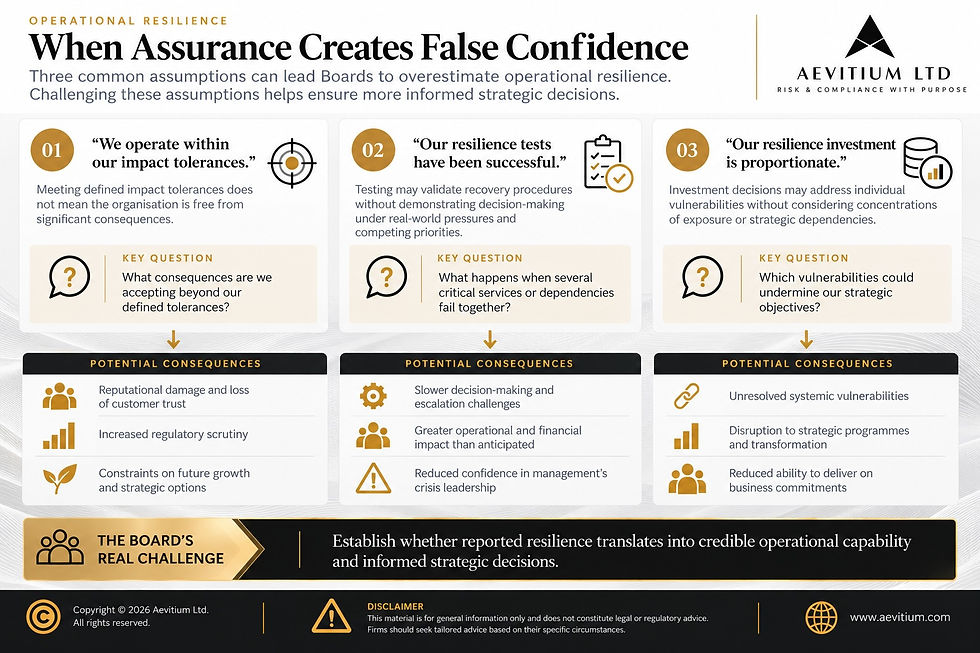
However, an organisation's exposure to disruption extends beyond its regulatory obligations. A failure may remain within defined impact tolerances while still damaging customer relationships, weakening market confidence, affecting reputation or constraining future growth. Equally, decisions that improve short-term operational efficiency may introduce dependencies or vulnerabilities that influence longer-term resilience.
Strategic resilience requires leadership to consider these wider consequences when making business decisions. This includes understanding how operational vulnerabilities interact with strategic priorities, how investment choices affect recovery capabilities and how disruption could influence the organisation's ability to deliver on its commitments.
This broader perspective also creates opportunities for competitive differentiation. Organisations that demonstrate reliable service delivery, effective crisis response and the ability to adapt under pressure can strengthen customer confidence, protect commercial relationships and pursue growth with greater assurance.
Operational resilience becomes a strategic capability when its insights inform business priorities, investment decisions and the organisation's capacity to sustain performance through disruption.
Discover how organisations can strengthen critical service delivery, manage interconnected vulnerabilities and demonstrate their ability to withstand, recover from and adapt to disruption.

The Board's Role: Setting Expectations and Challenging Assumptions
The Board plays a central role in determining how operational resilience is understood, prioritised and embedded within the organisation. Its responsibility extends beyond approving resilience policies and reviewing management reports. It must establish clear expectations about the organisation's ability to sustain critical services and navigate disruption while pursuing its strategic objectives.
Strategic alignment requires the Board to consider how growth, transformation and business model changes influence operational resilience. Expansion into new markets, technology modernisation or increased reliance on third parties can create opportunities while changing the organisation's exposure to disruption. Resilience considerations should inform strategic decisions from the outset.
Risk appetite and investment trade-offs require equally deliberate judgement. The Board must understand which vulnerabilities the organisation is prepared to accept, where additional investment is justified and how competing commercial priorities influence resilience. These decisions should reflect the potential consequences for customers, operations and long-term organisational performance.
Effective oversight depends on the quality of evidence presented to the Board. Completion of resilience activities, successful exercises and compliance indicators provide useful information, but their value depends on what they demonstrate about actual capabilities. Boards need visibility of material vulnerabilities, unresolved dependencies, plausible disruption scenarios and management's ability to make timely decisions under pressure.
This requires constructive challenge of the assumptions underpinning management's confidence in preparedness, including whether recovery capabilities remain credible as the organisation evolves.
Ultimately, effective Board oversight connects resilience expectations with strategic choices, risk appetite and demonstrated operational capability. It provides assurance grounded in evidence of how the organisation would perform when disruption tests its assumptions.
The CRO's Role: Connecting Risk, Strategy and Operational Reality
One of the CRO's most valuable contributions to operational resilience is identifying how ordinary business decisions can change the organisation's exposure to disruption, including when existing controls and recovery arrangements remain effective.
Consider an organisation that has invested in strengthening the resilience of its critical services. Individual vulnerabilities have been addressed, recovery capabilities tested and management assurance provided. Subsequent decisions to consolidate technology, outsource activities or streamline operations may nevertheless introduce new concentrations of exposure.
Each decision may be commercially justified and appropriately governed. Yet their combined consequences can fundamentally alter the organisation's resilience profile.
This creates a challenge for the CRO. Traditional risk assessments often examine individual activities, changes or vulnerabilities within defined organisational boundaries. The greater exposure may emerge from the interaction between decisions taken at different times, by different functions and for different objectives.
The CRO's role is to connect these decisions, challenge the assumptions underpinning them and assess their cumulative implications for critical services, risk appetite and strategic objectives.
Operational management remains accountable for resilience delivery and the consequences of its decisions. The CRO provides independent oversight and challenge, ensuring that decision-makers understand how changes in one part of the organisation may affect resilience elsewhere.
The strategic value of this perspective lies in identifying exposure as it develops through business decisions, rather than relying primarily on incidents, control failures or periodic assessments to reveal vulnerabilities.
Five Practical Ways CROs Can Identify Emerging Resilience Vulnerabilities
1. Get access to the decisions already being made. Establish a regular feed from investment committees, technology change boards, procurement and transformation programmes. Focus on decisions that alter critical dependencies, operating models or resource allocation. Use existing governance rather than introducing another approval process.
2. Maintain a simple register of material assumptions. For major strategic decisions, capture the two or three assumptions that underpin their resilience implications, such as supplier availability, recovery capacity or alternative processing arrangements. Assign an owner and identify what would trigger reconsideration. This makes it possible to detect when previously sound decisions become problematic.
3. Overlay change portfolios against shared dependencies. Use existing service maps to identify where multiple initiatives affect the same technology, supplier, team or operational capability. A simple matrix showing critical services against planned changes can reveal concentrations that individual project assessments overlook.
4. Revisit completed remediation when operating conditions change. Link material remediation actions to the vulnerabilities and assumptions they addressed. When a subsequent business change affects those conditions, trigger a targeted reassessment. This helps distinguish ineffective remediation from exposure recreated through later decisions.
5. Introduce a cumulative exposure review into existing executive reporting. Select the three most material changes to the organisation's resilience profile each quarter. For each, explain what has changed, which critical services are affected, whether existing capabilities remain sufficient and what management decision is required. This shifts reporting towards emerging vulnerabilities and actionable choices.
Resilience Investment: Making Better Strategic Trade-offs
Resilience investment competes with growth initiatives, technology transformation and operational efficiency. The challenge is determining where additional expenditure will meaningfully strengthen resilience and where existing capabilities already provide sufficient protection.
Investment decisions often prioritise visible weaknesses, such as ageing infrastructure, inadequate recovery capabilities or findings from scenario testing. However, addressing vulnerabilities individually may overlook the wider consequences of disruption or introduce new concentrations of exposure.
Consider an organisation modernising its legacy technology. Replacing ageing systems may improve reliability and reduce operating costs. Yet consolidating critical services onto a shared platform could increase the consequences of a single failure.
Three considerations should inform resilience investment decisions:
Consequences of failure: Which critical services, customers and strategic objectives would be affected, and what would prolonged disruption cost?
Effectiveness of existing capabilities: What evidence demonstrates that current arrangements can withstand disruption, and where would additional investment materially improve outcomes?
Strategic implications: How would the investment change operational dependencies, support future growth or introduce new vulnerabilities?
57%
Of respondents to Uptime Institute's 2025 survey reported that their most recent major outage cost more than $100,000. One in five reported costs exceeding $1 million.
These considerations help leadership compare alternative investments, assess the consequences of deferring remediation and identify opportunities to strengthen multiple services through shared improvements.
The objective is to allocate resources where they deliver the greatest organisational value. This requires investment decisions that reflect both the immediate vulnerabilities being addressed and the resilience implications of the organisation's evolving strategy.
Strengthen Your Operational Resilience Capability
Explore how Aevitium's Operational Resilience Pathway™ helps organisations assess operational resilience maturity, strengthen incident management and response capabilities, and improve their ability to withstand, respond to and recover from disruption.

Leadership Under Disruption: Where Resilience Is Demonstrated
When disruption occurs, leadership rarely has the luxury of complete information. The initial assessment may underestimate the scale of the problem, recovery estimates may change, and decisions taken to protect one service may create additional pressures elsewhere.
The 2018 TSB banking migration illustrates how quickly a technology disruption can develop into an enterprise-wide crisis. Customers experienced prolonged difficulties accessing banking services, while the consequences extended across customer support, operational recovery, regulatory scrutiny and reputation.
The significance of such incidents extends beyond the original technical failure. As disruption develops, leadership must determine when to escalate, which services to prioritise, what information can be communicated reliably and whether the existing response remains appropriate. These decisions become increasingly difficult when responsibilities are fragmented or different functions operate with competing priorities.
A particularly important consideration is the timing of intervention. Waiting for certainty may delay decisions until the consequences have intensified. Acting prematurely on incomplete assumptions can equally redirect resources towards the wrong priorities. Effective crisis leadership requires the judgement to distinguish emerging signals from established facts, recognise when assumptions need revisiting and adapt the response accordingly.
This is where resilience exercises can provide greater value. Beyond validating recovery procedures, they should expose leaders to deteriorating conditions, conflicting information and decisions that carry genuine operational and commercial consequences.
The defining test of leadership preparedness is whether the organisation can make coherent, timely decisions as the situation evolves, particularly when the original response is no longer sufficient.
Operational resilience depends as much on this capacity for judgement and adaptation as it does on the technical capabilities established before disruption.
4 in 5
Respondents in Uptime Institute's 2023 survey said their most recent serious outage could have been prevented with better management, processes and configuration.
Five Questions Board Directors Should Ask About Operational Resilience
Effective Board oversight requires confidence that operational resilience supports the organisation's strategic objectives and that management can demonstrate its effectiveness under pressure. Five questions can help directors challenge assumptions, evaluate investment priorities and assess the organisation's capacity to withstand disruption.
1. How are strategic and operational decisions changing our resilience exposure?
Examines whether technology transformation, outsourcing, cost optimisation and business growth are creating new dependencies or concentrations of risk, including where individual decisions have been appropriately assessed.
2. What evidence demonstrates that our resilience capabilities will work when they are needed?
Challenges management to distinguish between completed activities and demonstrated effectiveness, including whether testing reflects realistic disruption scenarios, interconnected failures and operational constraints.
3. Where would additional resilience investment deliver the greatest organisational value?
Assesses whether investment priorities reflect the consequences of failure, existing recovery capabilities, customer impacts and strategic objectives, rather than relying primarily on regulatory findings or isolated remediation requirements.
4. Can our leadership team make timely, coordinated decisions when information is incomplete?
Tests whether decision authority, escalation arrangements and crisis governance remain effective under pressure, particularly when circumstances deteriorate, priorities conflict or the initial response proves insufficient.
5. How do we know that previously addressed vulnerabilities have not been recreated through subsequent business decisions?
Examines whether changes to technology, suppliers, operating models and organisational structures trigger reassessment of earlier remediation, shared dependencies and the assumptions underpinning existing resilience arrangements.
Conclusion: Resilience as an Enduring Organisational Capability
Operational resilience is an enduring organisational capability, one that influences how confidently a business can pursue its objectives, respond to uncertainty and maintain the trust of customers and stakeholders.
Its effectiveness cannot be established at a single point in time. As organisations grow, transform and adapt to changing market conditions, their dependencies, vulnerabilities and capacity to withstand disruption evolve. Arrangements that were appropriate yesterday may no longer provide sufficient protection tomorrow.
For Boards and executive teams, the challenge is to ensure that resilience remains connected to organisational performance and strategic decision-making. This requires ongoing attention to how the business is changing, where exposure is accumulating and whether leadership remains equipped to respond when circumstances deteriorate.
Ultimately, effective governance and leadership turn operational resilience from a set of established arrangements into a capability that evolves with the organisation and supports sustainable performance.
About the Author: Julien Haye
Julien Haye is Managing Director of Aevitium LTD and a former Chief Risk Officer with over 26 years of experience across global financial services and non-profit organisations. Known for his pragmatic, people-first approach, he helps organisations strengthen risk management, governance and resilience to support better strategic decisions.
He is the author of The Risk Within: Cultivating Psychological Safety for Strategic Decision-Making and Resilient Risk Management (Kogan Page, 2026). He also hosts the RiskMasters podcast, where he explores risk, leadership and organisational resilience with industry leaders and change makers.
Frequently Asked Questions About Operational Resilience Strategy
1. How often should an organisation review its operational resilience strategy?
An operational resilience strategy should be reviewed at least annually and whenever material changes affect the business. Significant acquisitions, outsourcing arrangements, technology transformations, new products or changes in critical suppliers may warrant an earlier review. The appropriate frequency depends on the organisation's complexity, rate of change and exposure to disruption.
2. What are the leading indicators of deteriorating operational resilience?
Useful indicators include increasing dependency concentration, recurring service instability, unresolved recovery weaknesses, growing reliance on manual workarounds and delays in addressing critical vulnerabilities. Changes in supplier performance, operational capacity and the volume of simultaneous transformation initiatives can also signal emerging pressure before a major disruption occurs.
3. How can organisations measure the business value of operational resilience?
Value can be assessed through avoided disruption costs, reduced recovery times, improved service availability and greater confidence in critical operations. Organisations can also examine customer retention, operational efficiency and the ability to implement strategic changes without introducing unacceptable exposure. These measures should be considered alongside the cost of maintaining resilience capabilities.
4. How should operational resilience be considered during mergers and acquisitions?
Resilience due diligence should examine critical services, technology dependencies, third-party arrangements, recovery capabilities and operational vulnerabilities across both organisations. Particular attention should be given to integration risks, transitional arrangements and the possibility that combining operations creates new single points of failure. Findings should inform transaction valuation, integration planning and post-acquisition investment priorities.
5. Can an organisation become too dependent on its existing resilience arrangements?
Yes. Established recovery plans, alternative suppliers and contingency arrangements may become less effective as operating conditions change. For example, an alternative provider may develop dependencies on the same infrastructure as the primary supplier. Periodic reassessment should establish whether existing arrangements still provide genuine independence and sufficient recovery capacity.